You are already performing tasks typical of a business analyst, such as collecting requirements, documenting procedures, and bridging the gap between the business and technology teams. However, without the ECBA credential, you risk remaining in basic "analyst" or "coordinator" roles, while formally certified business analysts earn 40?60% higher salaries for the identical work. Human Resources systems eliminate candidates who lack this certification before their resume reaches hiring managers, and ECBA is often listed as a required qualification, not just a preferred one, in internal job postings. This program is designed to change that immediately. This offering is not another course that focuses on memorizing BABOK definitions. Our ECBA Training Program, created by IIBA-certified practitioners, teaches you how to implement business strategy and business process management in complex, real-world scenarios?including dealing with contradictory stakeholders, projects lacking a clear business case, and communication gaps between technical teams and executives. Unlike quick certification providers that focus only on exam shortcuts, we prioritize developing genuine capability. You will learn to: Lead requirements workshops that yield measurable outcomes instead of complaints. Craft user stories that developers can efficiently turn into implementations. Develop process models that stakeholders can comprehend without extensive explanations. Implement structured process improvement techniques that make you an essential asset in your position. The exam merely validates your knowledge?the true benefit is walking into your existing job and immediately utilizing established business analyst methods. We have structured this program for working professionals, offering weekday evening and weekend cohorts, fully interactive live Q&A, and recordings of every session for later review. In addition to classroom learning, you will receive: Requirements templates ready for immediate practical use. Case studies derived from banking, telecom, and e-commerce projects. Continuous (24/7) expert assistance and guidance through the IIBA application process to prevent common rejections. Strategies and practice to excel in interviews and showcase your applied BA competencies. Transform your existing experience into a formal business analyst qualification that provides access to increased salaries, improved roles, and greater career advancement opportunities.
ECBA Training Program Overview
Your ECBA Isn't a Certificate. It's Your Professional Career Catalyst
Why get ECBA-certified?
The Credential That Halts Role Restriction
Stop Being Filtered Out by HR
Earn the opportunity for BA interviews that match your potential, even without extensive documented professional experience.
Demonstrate Foundational Skill to Hiring Managers
Prove to managers that you have the core competence they require and won't risk placing unqualified analysts on key projects.
Transition to Strategic Roles
Move from technical support or manual testing roles into strategic business analysis positions where you design solutions rather than just carrying them out.
ECBA Training Course Highlights
IIBA Endorsed Education Provider (EEP) Status
Study with assurance knowing that your curriculum complies with the official IIBA BABOK? Guide requirements and professional standards.
Instruction by IIBA-Certified Practitioners
Master the profession from specialists who hold CBAP? or CCBA? credentials and currently work as active business analysts in the industry.
Adaptable Class Times
Start your business analysis career without disrupting your current employment by choosing from weekday-evening, weekend-only, or intensive 2-day bootcamp alternatives.
Results-Oriented Instruction
Quickly grasp the BA fundamentals with 21 hours of practical instruction and tailored feedback via more than eight knowledge area assessments.
Comprehensive Practice Resources
Identify and close any knowledge gaps using over 1000 customized practice questions, sample exams, and exercises based on real-world situations.
Around-the-Clock Expert Assistance and Support
Get immediate help and clarification on BABOK? concepts from IIBA-certified experts who are accessible 24 hours a day, 7 days a week.
Skills You Will Gain In Our ECBA Training Program
From Insight to Practical Wisdom
Who This Program Is For
Ideal Candidates for ECBA Certification
This certification training is ideal for:
If you are beginning your business analysis career or transitioning from technical or support positions, this program is specifically engineered to ensure you obtain your credential and are ready for the job market.
ECBA Certification Training Program Roadmap
The Step-by-Step System for First-Attempt Success

Eligibility and Pre-requisites
For ECBA Certification
The ECBA designation is intentionally set up as an entry-level certification, presenting minimal entry barriers. IIBA established this credential to confirm the foundational knowledge of professionals beginning their business analysis careers or moving from related roles. Here are the qualifications you must meet.
Course Modules
Comprehensive curriculum covering all exam domains
Business Analysis Fundamentals
Lesson 1: Introduction to Business Analysis
Understand what business analysts actually do versus what job descriptions claim. Learn the core competencies, underlying competencies, and techniques that define professional business analysis. Master the six knowledge areas of the BABOK? Guide and understand how they interconnect in real projects.
Lesson 2: Key Concepts in Business Analysis
Build your BA vocabulary with precise definitions that IIBA expects you to know. Learn the distinction between requirements, solutions, stakeholders, and value. Understand different requirement types, business, stakeholder, solution, and transition requirements and when each of these apply in which scenarios.
Lesson 3: The Business Analysis Planning & Monitoring Knowledge Area
Plan your approach before diving into elicitation. Gain expertise in stakeholder analysis, information management strategies, and defining the BA activities that can realistically be completed within project constraints. Apply business process management techniques to ensure efficiency and structured delivery in your projects.
Elicitation & Collaboration
Lesson 1: Preparing for Elicitation
Stop winging stakeholder meetings. You will learn how to prepare elicitation materials, select appropriate techniques, and secure stakeholder participation before the session even starts.
Lesson 2: Conducting Elicitation Activities
Master core techniques such as interviews, workshops, observation, document analysis, and surveys. Understand when to use each method and how to execute them efficiently, saving time while gathering accurate requirements.
Lesson 3: Confirming & Communicating Elicitation Results
Understand that what stakeholders say and what they mean are often different. Learn to compare elicitation results against other sources, resolve conflicts, and formally communicate findings to maintain alignment.
Requirements Lifecycle Management
Lesson 1: Tracing Requirements
Build traceability matrices that actually serve a purpose. Learn to trace requirements backward to business objectives and forward to solution components, ensuring nothing gets lost in translation.
Lesson 2: Maintaining Requirements
Manage the inevitable changes without creating chaos. You will learn how to maintain requirements attributes, prioritize conflicting demands, and version-control requirements as projects evolve.
Lesson 3: Prioritizing & Assessing Requirements Changes
Master techniques such as MoSCoW, Kano analysis, and weighted ranking to prioritize requirements objectively. Learn to assess change requests against business value and implementation cost, supporting process improvement initiatives and structured business process management.
Strategy Analysis & Requirements Analysis
Lesson 1: Analyzing Current State
Document how things work now before proposing how they should work. Learn to create as-is process models, identify pain points, and establish baselines for measuring improvement.
Lesson 2: Defining Future State
Design the to-be state that solves actual problems. You will learn gap analysis, capability assessment, and how to define solution scope that's achievable within organizational constraints.
Lesson 3: Specifying & Modeling Requirements
Transform ambiguous needs into precise specifications. Master techniques for functional decomposition, data modeling, user interface design, and creating requirements packages that developers can implement.
Solution Evaluation & Exam Preparation
Lesson 1: Measuring Solution Performance
Understand that implementation isn't the finish line. Learn to define success metrics, collect performance data, and assess whether solutions actually deliver the promised business value.
Lesson 2: Analyzing & Recommending Solution Improvements
Identify defects and recommend enhancements based on evidence, not opinions. You will learn root cause analysis and how to build business cases for solution improvements.
Lesson 3: Final Review & Certification Readiness
Consolidate your knowledge across all six BABOK? knowledge areas and address any remaining weak spots through targeted review. Complete final practice assessments and prepare for your certification journey with confidence.
Corporate Training
Tailored programs for teams with enterprise support

Ready to transform your team?
Get a custom quote for your organization's training needs.
Upcoming Schedule
Join the next batch that fits your timezone


Course & Support
Everything you need to know about our training options and support
Customer Testimonials
Hear from our successful graduates
"Exceptional PMP Training Experience with iCertGlobal I recently completed the PMP training by iCertGlobal, and I must say it was an outstanding experience. The instructor demonstrated a deep understanding of project management principles and brought real-world experience to the table. The training material's provided were comprehensive and well-organized, offering valuable insights and practical tips. I would highly recommend iCertGlobal to anyone looking for professional PMP Training.. "

John Anderson
"iCertGlobal provided a great learning experience with clear, well organised courses. The trainers were knowledgeable, and the support team was responsive to all my questions. The study material was comprehensive, which helped me pass my certification exam with ease. Highly recommended for anyone looking to get certified. "
James Walsh
"iCertGlobal is the best Certificate Training Organization. you will get good instructor and they will improve leaning sills and give the real time experience examples due to that you will get pass in first try. "
Andy Moran
"The course content, exam prep questions, interactive Q&A, and real-life examples made attending this PMP Project Management training class worth my time and money. The support from iCertGlobal was exceptional and I would like to thank them for accepting my request of meeting the trainer post the session for clearing my doubts."
Tim Malone
"I had a good learning experience with icertGlobal and it had been an amazing development journey. Actually, I accidentally bumped into iCertGlobal while searching for an online course for preparing my PMP examination. With positive reviews all over the internet and quick responses to my questions, I was flabbergasted enough to sign-up immediately. The instructor-led PMP preparatory course helped me both offline and online preparations. All the high-quality materials written in simple layman language was enough to grasp the gist of various topics. The instructors were very knowledgeable as they imparted not only their wealth of experiences but also real life examples. Thanks a lot iCertGlobal for imbibing this great learning experience. "
Jason Walter
"Thank you for your great course, great support, rapid response and excellent service."
Hoda Alavi
"My trainer made the materials relatable and easy to understand. It was fun being in class everyday. "
Cassandra Corn
"Amazing trainer who was very supportive. "

Shanna Pilgrim
"Trainer was well versed in the subject matter and got the impression the gentleman was professional and educated within standards and procedures for PMI. "
Anthony Zamora
"The Training was good and customer service was perfect. "
Maka Diakhate
"Trainer was knowledgeable and lesson's pace was just right."

Roger Gonzales
"Trainer (Bruce) was very excellent in delivery and presentation. He provided me with all the tools required to be successful in the PMP exams with lots of quiz questions on all topics reviewed. "
Bashiru Ojibara
"The trainer, Emad was top notch and very knowledgeable. He is up to date with all current versions and is great in 1:1 Training. "

Jonathan Obien
"Thank you for your great course, great support, rapid response and excellent service"

Hoda Alavi
"Marc had very good knowledge and he was able to explain the material and provide guidance to get ready for the test. "

Roque Montesino
"Excellent Course. Zahn was a great instructor and the course material definitely will help me pass the PMP Exam "

Jared Nelson
"Great teacher, went out of his way in every possible aspect. "
Radiah Sims
"Customer service provided by Robin was great as he was very responsive and the trainer, John, was very good at relating the content to my industry. "

Jason D Niebauer
ECBA Training in Other Cities
Our ECBA certification training is available in major cities worldwide
Related Blogs
Stay updated with the latest insights and trends in project management
8 Best Practices for Successful Business Analysts
Learn 8 proven best practices for Business Analysts to master requirements, manage stakeholders, and drive project value. Expert...
Why Should I Invest in ECBA? Is ECBA
Explore why the ECBA Certification is a must-have for new BAs. Learn about ECBA career benefits, salary hikes,...
How to Pass the ECBA Exam on Your
Master ECBA exam prep in 2026 with expert study tips, a detailed blueprint, and strategies for experienced professionals...
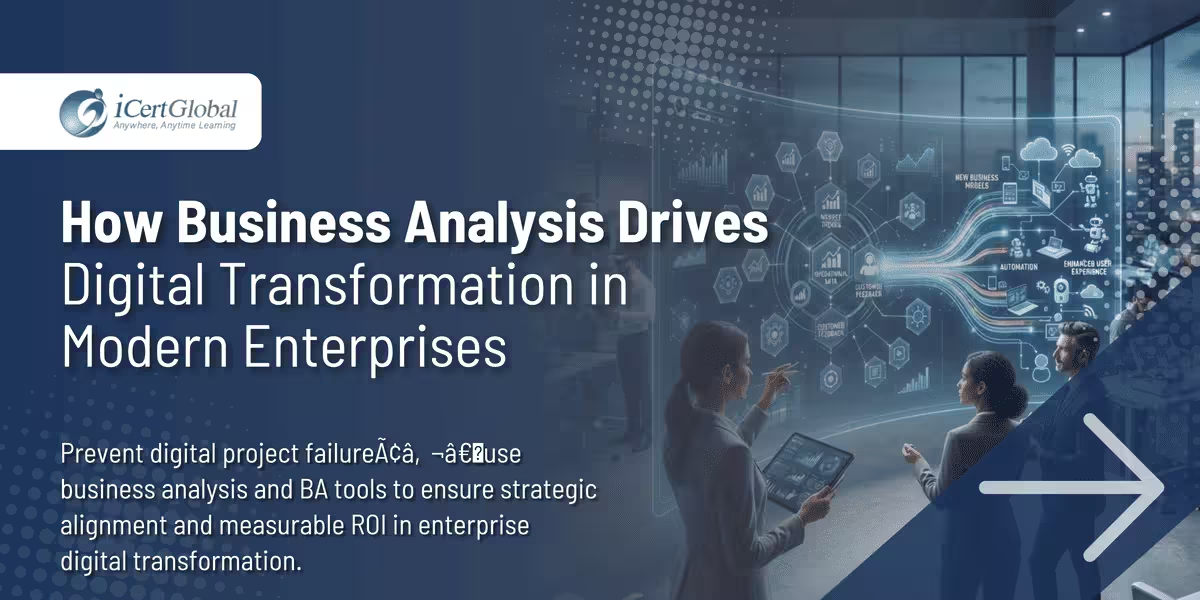
How Business Analysis Drives Digital Transformation in Modern
Prevent digital project failure—use business analysis and BA tools to ensure strategic alignment and measurable ROI in enterprise...

Top 7 Reasons to Start a Career as
Explore 7 key reasons a Business Analytics career boosts ROI and growth for senior professionals (10+ yrs). Gain...
How SWOT Analysis Can Turn Weaknesses into Opportunities
Master SWOT Analysis Beyond the Basics: Discover how seasoned professionals turn Weaknesses into Opportunities and leverage Risk Assessment...