The Lean Six Sigma Black Belt certification training is an advanced program designed for professionals who want to lead high-impact process improvement initiatives and drive measurable business results. iCert Global’s lean six sigma black belt certification course will help you master the DMAIC framework (Define, Measure, Analyze, Improve, Control), advanced statistical techniques, Lean methodologies, and leadership skills required to solve complex business challenges. Through practical learning, real-world projects, and expert guidance, you will develop the ability to identify process gaps, analyze root causes, optimize operations, reduce waste, and implement sustainable improvements across organizations. Understand how Modern Black Belts combine traditional Lean Six Sigma expertise with emerging technologies to improve efficiency, predict performance issues, and create long-term value.
Lean Six Sigma Black Belt Certification Course Overview
Comprehensive DMAIC Methodology Training
Why Get Lean Six Sigma Black Belt Certified?
Become a Leader in Quality and Operational Excellence
Advance Your Career & Leadership Opportunities
Build the skills and credibility needed to take on leadership roles in quality management, process excellence, operations, and business transformation.
Master Advanced Problem-Solving Skills
Learn how to use DMAIC, statistical analysis, and root cause analysis to solve complex business problems with data-driven decisions.
Become a Change Management Leader
Throughout the LSSBB certification training, you can strengthen your ability to lead cross-functional teams, manage improvement initiatives, and drive a culture of continuous improvement.
Increase Career Value & Earning Potential
Stand out with an LSSBB certification that validates your ability to deliver measurable business improvements and lead strategic projects.
Gain Global Recognition Across Industries
Apply your Lean Six Sigma expertise across industries such as manufacturing, healthcare, IT, finance, and supply chain worldwide.
Lean Six Sigma Black Belt Certification Course Highlights
Hands-On Training with Real-World Business Improvement Projects
Master Black Belt–Designed Curriculum
Enrol in the 4-day Lean Six Sigma Black Belt certification bootcamp & learn from a curriculum built around the complete Six Sigma Black Belt Body of Knowledge.
Learn from Certified Master Black Belts
Gain practical insights from experienced Master Black Belt trainers who have led large-scale business transformation projects across industries.
Flexible Learning Options
Choose a schedule that fits your professional commitments with weekday sessions, weekend batches, or an intensive bootcamp format.
Advanced Statistical Expertise
The Black Belt 6 Sigma training helps you master advanced techniques like DOE, hypothesis testing, multivariate analysis, and reliability engineering to solve complex business problems.
Industry-Focused Tool Training
Build hands-on expertise with tools like Minitab, JMP, and advanced Excel for data analysis, reporting, and process improvement.
Real-World Project Application
Apply Lean Six Sigma concepts through practical projects, financial impact analysis, and executive-level problem-solving approaches.
24/7 Expert Guidance & Support
Throughout the Lean Six Sigma Black Belt certification training, get continuous support from certified experts to clarify concepts, solve challenges, and confidently progress through your Black Belt journey.
Skills You Will Master in Lean Six Sigma Black Belt Certification Training
Lean Waste Identification and Elimination Strategies
Who Should Enroll for the Lean Six Sigma Black Belt Certification Training?
Quality and Process Improvement Professionals
This certification training is ideal for:
If you are currently leading complex improvement initiatives, managing cross-functional teams, and are ready to deliver cost reductions in the six-figure range, this program will provide you with the advanced tools and strategic frameworks essential for success.
Lean Six Sigma Black Belt Certification Training Roadmap
Apply Lean Six Sigma Tools Through Practical Projects

Prerequisites & Eligibility for Lean Six Sigma Black Belt Certification
Factors to consider before enrolling in Lean Six Sigma Black Belt Training
Course Modules
Comprehensive curriculum covering all exam domains
Define Phase & Enterprise Leadership
Lesson 1: Strategic Project Selection & Charter Development
Learn to identify projects that matter to leadership by connecting process problems to strategic business objectives. Master the project charter structure that secures executive sponsorship, funding, and cross-functional resources. Understand how to quantify opportunity size, define measurable goals, and set realistic timelines that account for organizational constraints.
Lesson 2: Voice of Customer & Critical-to-Quality Translation
Transform vague customer complaints into specific, measurable process requirements using Kano analysis and CTQ trees. Gain expertise in advanced Lean Six Sigma Black Belt training methods for collecting VOC data across B2B and B2C contexts, including conjoint analysis and MaxDiff studies. Prioritize conflicting customer needs using weighted criteria aligned with business strategy?skills that increase your value in Lean Six Sigma Black Belt jobs.
Lesson 3: Stakeholder Analysis & Change Management Foundation
Map your stakeholder landscape to identify supporters, resistors, and influencers who can determine your project's success. Master Lean Six Sigma Black Belt certification online strategies for stakeholder engagement, communication planning, and resistance management. Learn to navigate organizational politics, build support, and influence decision-makers?essential for improving your Lean Six Sigma Black Belt salary potential and establishing credibility as a certified professional.
Measure Phase & Advanced Metrology
Lesson 1: Measurement System Analysis & Gage R&R
Stop making decisions based on garbage data from unreliable measurement systems. Learn to quantify measurement error using Gage R&R studies for continuous and attribute data. Master the interpretation of %GRR, discrimination ratios, and number of distinct categories to determine whether your data is trustworthy enough for decision-making.
Lesson 2: Process Capability Analysis & Sigma Level Calculation
Understand whether your process is capable of meeting specifications before launching improvement efforts that can't possibly succeed. Calculate and interpret $C_p$, $C_{pk}$, $P_p$, and $P_{pk}$ indices for both normal and non-normal distributions. Learn when capability studies mislead you and how to account for real-world complications like multiple specifications and small sample sizes.
Lesson 3: Data Collection Strategy & Sampling Methods
Design data collection plans that balance statistical rigor with resource constraints in real organizations. Master sampling techniques including stratified, systematic, and cluster sampling. Learn to determine appropriate sample sizes for different statistical tests and avoid the common sampling biases that invalidate your conclusions.
Analyze Phase & Root Cause Investigation
Lesson 1: Hypothesis Testing & Statistical Significance
Move beyond anecdotal evidence to statistically validated conclusions about process behavior. Master the full range of hypothesis tests: t-tests, ANOVA, chi-square, proportion tests, and non-parametric alternatives. Learn to interpret p-values correctly, understand Type I and Type II errors, and determine the practical significance versus statistical significance of your findings.
Lesson 2: Regression Analysis & Correlation Studies
Determine which input variables truly drive your outputs and separate signal from noise. Build and validate linear regression models, interpret R-squared and residual plots, and detect multicollinearity. Advanced techniques such as stepwise regression and polynomial regression help you tackle non-linear relationships. This analytical expertise is a core part of any Lean Six Sigma Black Belt course and vital for Lean Six Sigma Black Belt certification online preparation.
Lesson 3: Multi-Vari Analysis & Graphical Root Cause Methods
Investigate complex problems using Multi-Vari charts to reveal positional, cyclical, and temporal variation patterns. Facilitate advanced fishbone diagrams, conduct 5-Why analysis, and leverage scatter plots for insight. Communicate findings visually to non-technical stakeholders?an indispensable skill for professionals holding a Lean Six Sigma Black Belt.
Improve Phase & Design of Experiments
Lesson 1: Screening Experiments & Factorial Designs
Stop wasting time with trial-and-error improvements and leverage Lean Six Sigma Black Belt certification knowledge to systematically optimize processes. Learn to design and execute full factorial and fractional factorial experiments to identify main effects and interactions. Understand confounding patterns, resolution levels, and selecting the right design based on your factors and resources?critical skills for Lean Six Sigma Black Belt jobs and improving your Lean Six Sigma Black Belt salary.
Lesson 2: Response Surface Methodology & Optimization
Once you've identified key factors, use RSM to find optimal settings that maximize performance. Master central composite designs, Box-Behnken designs, and contour plot interpretation. Learn to handle multiple responses with conflicting objectives using desirability functions and create robust parameter settings that work across varied conditions.
Lesson 3: Mistake-Proofing & Lean Solution Implementation
Design solutions that prevent defects rather than detect them after they occur using Poka-Yoke principles. Learn the hierarchy of error-proofing from elimination and replacement through facilitation and detection. Master Lean concepts including value stream mapping, 5S workplace organization, SMED setup reduction, and pull systems that eliminate waste from your improved process.
Control Phase & Sustainability
Lesson 1: Statistical Process Control & Control Chart Design
Prevent your hard-won improvements from degrading over time through proper process monitoring. Design and implement control charts (X-bar, R, I-MR, P, NP, C, U) appropriate for your data type. Learn to calculate control limits, interpret special cause patterns, and establish effective response plans when processes signal out-of-control conditions.
Lesson 2: Control Plans & Process Documentation
Create comprehensive control plans that specify what to measure, how frequently, who's responsible, and what actions to take when problems arise. Develop standard work instructions that capture new procedures in a way that operators can actually follow. Learn documentation strategies that survive organizational turnover and maintain process stability.
Lesson 3: Project Financial Validation & Closure
Quantify and validate your project's financial impact using methods that finance teams and external auditors will accept. Distinguish between hard savings, soft savings, and cost avoidance. Calculate return on investment, payback period, and net present value. Prepare compelling project reports and executive presentations that showcase business results, not just statistical analysis.
Corporate Training
Tailored programs for teams with enterprise support

Ready to transform your team?
Get a custom quote for your organization's training needs.
Upcoming Schedule
Join the next batch that fits your timezone


Course & Support
Everything you need to know about our training options and support
DMAIC methodology,
Lean principles and waste elimination,
Advanced statistical analysis,
Process mapping and optimization,
Hypothesis testing and regression,
Design of Experiments (DOE),
SPC, Control Charts, FMEA, Kaizen, and Poka-Yoke.
Customer Testimonials
Hear from our successful graduates
"Exceptional PMP Training Experience with iCertGlobal I recently completed the PMP training by iCertGlobal, and I must say it was an outstanding experience. The instructor demonstrated a deep understanding of project management principles and brought real-world experience to the table. The training material's provided were comprehensive and well-organized, offering valuable insights and practical tips. I would highly recommend iCertGlobal to anyone looking for professional PMP Training.. "

John Anderson
"iCertGlobal provided a great learning experience with clear, well organised courses. The trainers were knowledgeable, and the support team was responsive to all my questions. The study material was comprehensive, which helped me pass my certification exam with ease. Highly recommended for anyone looking to get certified. "
James Walsh
"iCertGlobal is the best Certificate Training Organization. you will get good instructor and they will improve leaning sills and give the real time experience examples due to that you will get pass in first try. "
Andy Moran
"The course content, exam prep questions, interactive Q&A, and real-life examples made attending this PMP Project Management training class worth my time and money. The support from iCertGlobal was exceptional and I would like to thank them for accepting my request of meeting the trainer post the session for clearing my doubts."
Tim Malone
"I had a good learning experience with icertGlobal and it had been an amazing development journey. Actually, I accidentally bumped into iCertGlobal while searching for an online course for preparing my PMP examination. With positive reviews all over the internet and quick responses to my questions, I was flabbergasted enough to sign-up immediately. The instructor-led PMP preparatory course helped me both offline and online preparations. All the high-quality materials written in simple layman language was enough to grasp the gist of various topics. The instructors were very knowledgeable as they imparted not only their wealth of experiences but also real life examples. Thanks a lot iCertGlobal for imbibing this great learning experience. "
Jason Walter
"Thank you for your great course, great support, rapid response and excellent service."
Hoda Alavi
"My trainer made the materials relatable and easy to understand. It was fun being in class everyday. "
Cassandra Corn
"Amazing trainer who was very supportive. "

Shanna Pilgrim
"Trainer was well versed in the subject matter and got the impression the gentleman was professional and educated within standards and procedures for PMI. "
Anthony Zamora
"The Training was good and customer service was perfect. "
Maka Diakhate
"Trainer was knowledgeable and lesson's pace was just right."

Roger Gonzales
"Trainer (Bruce) was very excellent in delivery and presentation. He provided me with all the tools required to be successful in the PMP exams with lots of quiz questions on all topics reviewed. "
Bashiru Ojibara
"The trainer, Emad was top notch and very knowledgeable. He is up to date with all current versions and is great in 1:1 Training. "

Jonathan Obien
"Thank you for your great course, great support, rapid response and excellent service"

Hoda Alavi
"Marc had very good knowledge and he was able to explain the material and provide guidance to get ready for the test. "

Roque Montesino
"Excellent Course. Zahn was a great instructor and the course material definitely will help me pass the PMP Exam "

Jared Nelson
"Great teacher, went out of his way in every possible aspect. "
Radiah Sims
"Customer service provided by Robin was great as he was very responsive and the trainer, John, was very good at relating the content to my industry. "

Jason D Niebauer
Lean Six Sigma Black Belt Training in Other Cities
Our Lean Six Sigma Black Belt certification training is available in major cities worldwide
Related Blogs
Stay updated with the latest insights and trends in project management
Six Sigma Belt Levels Explained: Yellow, Green, and
Advance your career by mastering Six Sigma belt levels. Learn the differences between Yellow, Green, and Black Belts...
How to Prepare for the Six Sigma Green
Master the DMAIC methodology and pass your Six Sigma Green Belt Certification Exam. Learn proven study strategies to...
10 Industries Where Lean Six Sigma Green Belt
Advance your career with Lean Six Sigma Green Belt skills. Explore the top 10 industries actively hiring certified...
Understanding Key Lean Six Sigma Principles for Exam
Master essential lean six sigma principles to pass your certification exam, eliminate process waste, and advance your career....
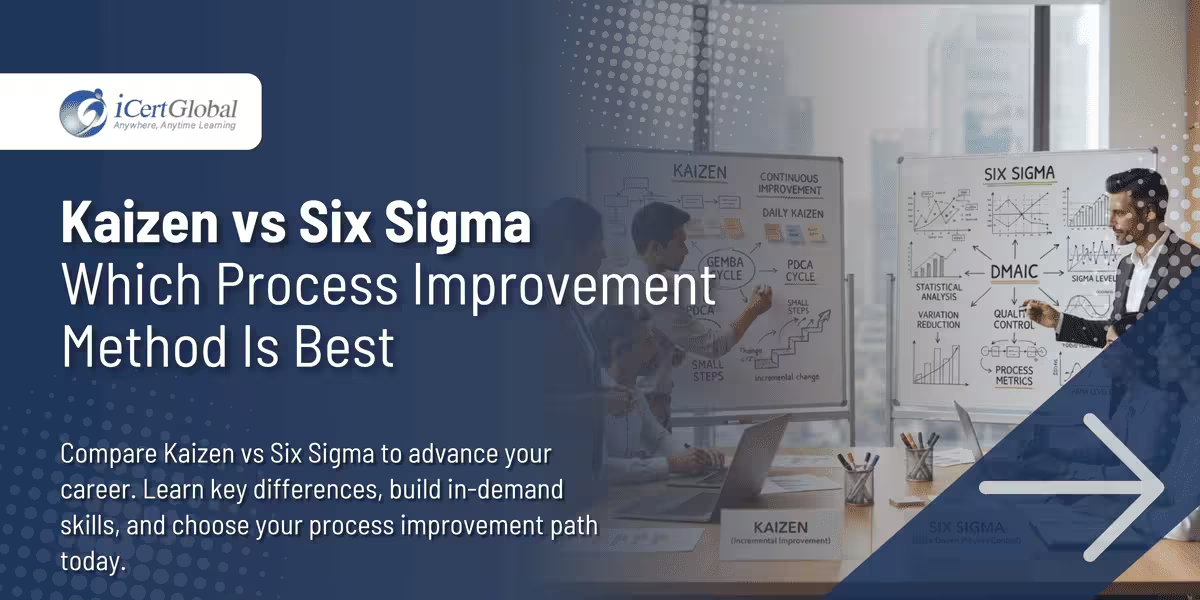
Kaizen vs Six Sigma Which Process Improvement Method
Compare Kaizen vs Six Sigma to advance your career. Learn key differences, build in-demand skills, and choose your...
Six Sigma vs TQM: Key Differences Explained
Advance your career by mastering quality management. Discover the key differences between Six Sigma and TQM to choose...