Your Six Sigma Green Belt Certification is more than just a document?it signifies authentic project leadership capability. Many quality, operations, or process improvement professionals find it difficult to demonstrate their competence because they lack formal Six Sigma Green Belt certification. You may already recognize process flaws like delays, inefficiencies, and defects, but without Six Sigma's structured tools and statistical methods, your ideas may sound like mere opinions instead of data-driven insights. Conversely, Six Sigma Green Belt certified professionals confidently lead improvement projects, use analytical thought to determine fundamental causes, and produce quantifiable cost savings that lead to raises (up to 30% higher salaries), recognition, and promotions. The difference is rooted in structured problem-solving, not intellect, which is precisely what this program offers. This Six Sigma Green Belt Course is a practical, hands-on program created by experienced Black Belts and Master Black Belts who have successfully led hundreds of projects in sectors like manufacturing, IT services, and healthcare; it is not a theoretical statistics class filled with specialized terminology. They are aware of real-world organizational constraints, such as political complexities, tight timelines, and limited budgets, and designed this Six Sigma Green Belt Certification Training to prepare you to manage these challenges. You will be taught how to implement the DMAIC methodology to set improvement objectives, measure process performance using data, analyze results to uncover true root causes, implement lasting solutions, and establish control mechanisms to stop problems from recurring. Unlike generic courses, this six sigma green belt certification online program combines strategy, tools, and techniques into a comprehensive learning experience. You won't simply memorize statistical vocabulary; you'll learn to clearly and confidently communicate your findings, translating technical results into business impacts your management can understand. Upon completing this training, you will possess not only a globally recognized Six Sigma Green Belt certification but also the competence to independently lead your initial improvement project?from identifying opportunities to presenting demonstrable savings to your leaders. This program, designed for working professionals in services, quality, manufacturing, and operations, provides flexible weekend and evening class times, with all sessions conducted live and recorded for your convenience. The six sigma green belt certification cost is structured to keep professional skill development affordable while maintaining top-tier training and personalized mentorship. You'll receive access to Minitab practice exercises, real project templates, control plan formats, and continuous support from certified Black Belts. What distinguishes this program is its focus on guided project completion?while many training providers conclude their support after the theory ends, we remain with you until your Green Belt project is successfully executed. Achieving your Six Sigma Green Belt Certification is a professional transformation, not just an academic achievement. It equips you with the means to solve problems scientifically, lead diverse teams, and demonstrate measurable enhancements in efficiency, quality, and cost. Whether you aim to boost your six sigma green belt salary, prepare for Black Belt certification, or secure leadership positions in process excellence, this program provides you with the global credibility and practical skills necessary to succeed. Enroll now in our Six Sigma Green Belt Certification Training and take your first confident stride toward becoming a data-driven project leader.
Six Sigma Green Belt Training Program
Your LSSGB Isn't a Certificate. It's How You Stop Spotting Problems and Start Leading the Fix
Why get Six Sigma Green Belt-certified?
The Credential That Ends the Gatekeeping
Stop Being Invisible to Recruiters
Bypass common HR screening filters and secure interviews for process improvement and quality management positions that align with your experience.
Quantify Your Value in Hard Numbers
Prove your Return on Investment through verifiable documentation of defect reduction and cost savings, directly supporting promotion and bonus structures.
Transition from Firefighting to Strategic Improvement
Advance beyond simply reacting to urgent issues and start preventing problems through the establishment of data-driven process control and design.
Six Sigma Green Belt Training Course Highlights
More Than a Course - It's Your Career Accelerator
Accredited Training Provider
Learn with assurance that your educational program adheres to international Six Sigma Body of Knowledge standards and is globally accepted by hiring organizations.
Taught by Certified Black Belts
Maximize your potential with expert teachers who are certified Six Sigma Black Belts and possess real-world experience leading projects across numerous industries.
Flexible Learning Schedule
Balance obtaining certification with your current employment by choosing from weekday-evening sessions, weekend-only classes, or an intense 5-day immersive bootcamp.
Hands-On Project Training
Master the concepts using actual data analysis, not just theory, through guided DMAIC project work and practical sessions with statistical software.
Complete Statistical Toolkit
Achieve competence in professional-grade tools with included Minitab software access, templates for process mapping, and thorough guides for calculations.
24/7 Expert Support Network
Eliminate confusion with certified Black Belt instructors available around the clock to help you solve your statistical questions and methodological concerns.
Skills You Will Gain In Our Six Sigma Green Belt Training Program
From Knowledge to Actionable Intelligence
Who This Program Is For
Ideal Candidates for Six Sigma Green Belt Certification
This certification training is ideal for:
If you are currently responsible for operational excellence, enhancing quality, or optimizing processes within your organization, this program is specifically designed to provide you with the practical skills and recognized credential that employers require.
Six Sigma Green Belt Certification Training Program Roadmap
The Step-by-Step System for First-Attempt Success

Eligibility and Pre-requisites
For SSGB Certification
Unlike the PMP, there are no rigid work experience requirements for Six Sigma Green Belt certification imposed by a governing body. However, this does not mean the certification is suitable for everyone. To be an effective Green Belt, you must have certain foundational knowledge and experience. Here is what you should already possess before pursuing this credential:
Course Modules
Comprehensive curriculum covering all exam domains
Module 1: Six Sigma Foundation & Define Phase
Lesson 1: Six Sigma Philosophy & Business Impact
Master the fundamental principles of Six Sigma including the history, methodology evolution, and the critical business case for process improvement. Learn to calculate the cost of poor quality (COPQ) and understand why executives greenlight Six Sigma initiatives. Distinguish between DMAIC for existing processes and DFSS for new product/process design.
Lesson 2: Define Phase Mastery
Build rock-solid project foundations through proper problem statements, project charters, and SIPOC diagrams. Learn to define CTQ (Critical to Quality) characteristics that actually matter to customers, not just internal metrics. Master stakeholder analysis and create realistic project timelines that account for data collection and organizational resistance.
Lesson 3: Voice of Customer & Requirements Translation
Transform vague customer complaints into measurable process requirements. Learn multiple VOC collection methods including surveys, interviews, and Kano analysis. Understand how to translate qualitative feedback into quantitative specifications that guide your improvement efforts and prevent scope creep.
Module 2: Measure Phase & Data Collection
Lesson 1: Measurement System Analysis (MSA)
Stop making decisions based on bad data. Master Gage R&R studies to assess whether your measurement system is capable of detecting real process variation versus measurement error. Learn when your data is trustworthy and when you need to fix your measurement process before proceeding.
Lesson 2: Process Capability & Performance Metrics
Learn to assess whether your process meets specifications and quantify exactly how far you are from customer requirements. In the Six Sigma Green Belt Certification online program, you?ll calculate and interpret key capability indices like Cp, Cpk, Pp, and Ppk.
Lesson 3: Data Collection Strategy & Sampling Design
Design efficient data collection plans that reflect process reality without consuming excessive resources. This Six Sigma Green Belt certification segment teaches you to apply advanced sampling techniques, differentiate between continuous and discrete data, and use stratification to uncover hidden process patterns.
Module 3: Analyze Phase & Statistical Analysis
Lesson 1: Descriptive Statistics & Graphical Analysis
Move beyond gut feel by visualizing your data through histograms, boxplots, and scatter diagrams that reveal patterns invisible in raw numbers. Calculate meaningful summary statistics and understand when mean, median, or mode is the appropriate measure of central tendency. Learn to spot outliers and decide whether to investigate or remove them.
Lesson 2: Hypothesis Testing & Inferential Statistics
Determine whether observed differences are statistically significant or just random noise. Master t-tests, ANOVA, chi-square tests, and understand the critical concepts of p-values, confidence intervals, and Type I/Type II errors. Learn to select the correct statistical test based on your data type and sample size.
Lesson 3: Correlation, Regression & Root Cause Identification
Quantify relationships between input variables and output performance through correlation and regression analysis ? core tools covered in the Six Sigma Green Belt course. Understand the difference between correlation and causation to prevent misleading conclusions.
Module 4: Improve Phase & Solution Implementation
Lesson 1: Design of Experiments (DOE) Fundamentals
Stop testing one variable at a time. Learn factorial experiment design that reveals interaction effects and optimizes multiple factors simultaneously. Understand confounding, randomization, and blocking to design efficient experiments that deliver maximum information from minimum runs. Master how to analyze DOE results in Minitab and identify optimal factor settings.
Lesson 2: Lean Tools & Waste Elimination
Improving quality is only half the battle ? eliminating inefficiency is the other. In this Six Sigma Green Belt certification phase, you?ll learn to recognize and eliminate the eight types of waste (DOWNTIME).
Lesson 3: Solution Selection & Pilot Testing
Learn to identify and implement the best improvement solutions using data-driven decision-making. Through this Six Sigma Green Belt certification online lesson, you?ll use criteria matrices to evaluate potential solutions based on effectiveness, cost, feasibility, and risk.
Module 5: Control Phase & Sustaining Improvement
Lesson 1: Statistical Process Control (SPC) Charts
Implement control charts that distinguish between normal process variation and signals requiring intervention. Master X-bar and R charts, I-MR charts, p-charts, and c-charts depending on your data type. Learn the Western Electric rules for detecting out-of-control conditions and understand why reacting to common cause variation makes your process worse, not better.
Lesson 2: Control Plans & Process Documentation
Build comprehensive control plans that prevent process drift after you've achieved improvement. Document critical process parameters, monitoring frequencies, reaction plans, and ownership. Create standard operating procedures (SOPs) that are actually usable by operators, not bureaucratic paperweights that gather dust on shelves.
Lesson 3: Change Management & Benefit Realization
Realize that technical solutions fail without organizational buy-in. Learn to overcome resistance to change, train process owners on new procedures, and establish accountability for sustaining improvements. Master how to track and report financial benefits using your organization's accounting methodology to get credit for the value you've delivered.
Corporate Training
Tailored programs for teams with enterprise support

Ready to transform your team?
Get a custom quote for your organization's training needs.
Upcoming Schedule
Join the next batch that fits your timezone


Course & Support
Everything you need to know about our training options and support
Customer Testimonials
Hear from our successful graduates
"Exceptional PMP Training Experience with iCertGlobal I recently completed the PMP training by iCertGlobal, and I must say it was an outstanding experience. The instructor demonstrated a deep understanding of project management principles and brought real-world experience to the table. The training material's provided were comprehensive and well-organized, offering valuable insights and practical tips. I would highly recommend iCertGlobal to anyone looking for professional PMP Training.. "

John Anderson
"iCertGlobal provided a great learning experience with clear, well organised courses. The trainers were knowledgeable, and the support team was responsive to all my questions. The study material was comprehensive, which helped me pass my certification exam with ease. Highly recommended for anyone looking to get certified. "
James Walsh
"iCertGlobal is the best Certificate Training Organization. you will get good instructor and they will improve leaning sills and give the real time experience examples due to that you will get pass in first try. "
Andy Moran
"The course content, exam prep questions, interactive Q&A, and real-life examples made attending this PMP Project Management training class worth my time and money. The support from iCertGlobal was exceptional and I would like to thank them for accepting my request of meeting the trainer post the session for clearing my doubts."
Tim Malone
"I had a good learning experience with icertGlobal and it had been an amazing development journey. Actually, I accidentally bumped into iCertGlobal while searching for an online course for preparing my PMP examination. With positive reviews all over the internet and quick responses to my questions, I was flabbergasted enough to sign-up immediately. The instructor-led PMP preparatory course helped me both offline and online preparations. All the high-quality materials written in simple layman language was enough to grasp the gist of various topics. The instructors were very knowledgeable as they imparted not only their wealth of experiences but also real life examples. Thanks a lot iCertGlobal for imbibing this great learning experience. "
Jason Walter
"Thank you for your great course, great support, rapid response and excellent service."
Hoda Alavi
"My trainer made the materials relatable and easy to understand. It was fun being in class everyday. "
Cassandra Corn
"Amazing trainer who was very supportive. "

Shanna Pilgrim
"Trainer was well versed in the subject matter and got the impression the gentleman was professional and educated within standards and procedures for PMI. "
Anthony Zamora
"The Training was good and customer service was perfect. "
Maka Diakhate
"Trainer was knowledgeable and lesson's pace was just right."

Roger Gonzales
"Trainer (Bruce) was very excellent in delivery and presentation. He provided me with all the tools required to be successful in the PMP exams with lots of quiz questions on all topics reviewed. "
Bashiru Ojibara
"The trainer, Emad was top notch and very knowledgeable. He is up to date with all current versions and is great in 1:1 Training. "

Jonathan Obien
"Thank you for your great course, great support, rapid response and excellent service"

Hoda Alavi
"Marc had very good knowledge and he was able to explain the material and provide guidance to get ready for the test. "

Roque Montesino
"Excellent Course. Zahn was a great instructor and the course material definitely will help me pass the PMP Exam "

Jared Nelson
"Great teacher, went out of his way in every possible aspect. "
Radiah Sims
"Customer service provided by Robin was great as he was very responsive and the trainer, John, was very good at relating the content to my industry. "

Jason D Niebauer
"Excellent "

Roger Muyani
"The instructor (Houssin) was great. There was a lot of good course material provided. There were few exam questions outside the covered subject matter. However, I would say that the overall experience was positive and that I learned a lot. "

Mike
"Customer service provided by Robin was great as he was very responsive and the trainer, John, was very good at relating the content to my industry. "

Anthony Nguyen
"The actual class was outstanding and the on-line course was thorough and effective. I am more confident now to pass the exam. "
 Hefner.jpg)
Denise R Hefner
"The trainer was excellent. Very knowledgeable and was able to answer my questions along the way. "

Jason Blezard
"The pace of the course was good. Attending multiple sessions provided me great insights on the course. "
Keith Lowder
"Its the very useful course to complete the PMP. Sure the Provided materials will help us to clear the PMP. "

Sivanesan Viswanathan
Six Sigma Green Belt Training in Other Cities
Our Six Sigma Green Belt certification training is available in major cities worldwide
Related Blogs
Stay updated with the latest insights and trends in project management
Six Sigma Belt Levels Explained: Yellow, Green, and
Advance your career by mastering Six Sigma belt levels. Learn the differences between Yellow, Green, and Black Belts...
How to Prepare for the Six Sigma Green
Master the DMAIC methodology and pass your Six Sigma Green Belt Certification Exam. Learn proven study strategies to...
10 Industries Where Lean Six Sigma Green Belt
Advance your career with Lean Six Sigma Green Belt skills. Explore the top 10 industries actively hiring certified...
Understanding Key Lean Six Sigma Principles for Exam
Master essential lean six sigma principles to pass your certification exam, eliminate process waste, and advance your career....
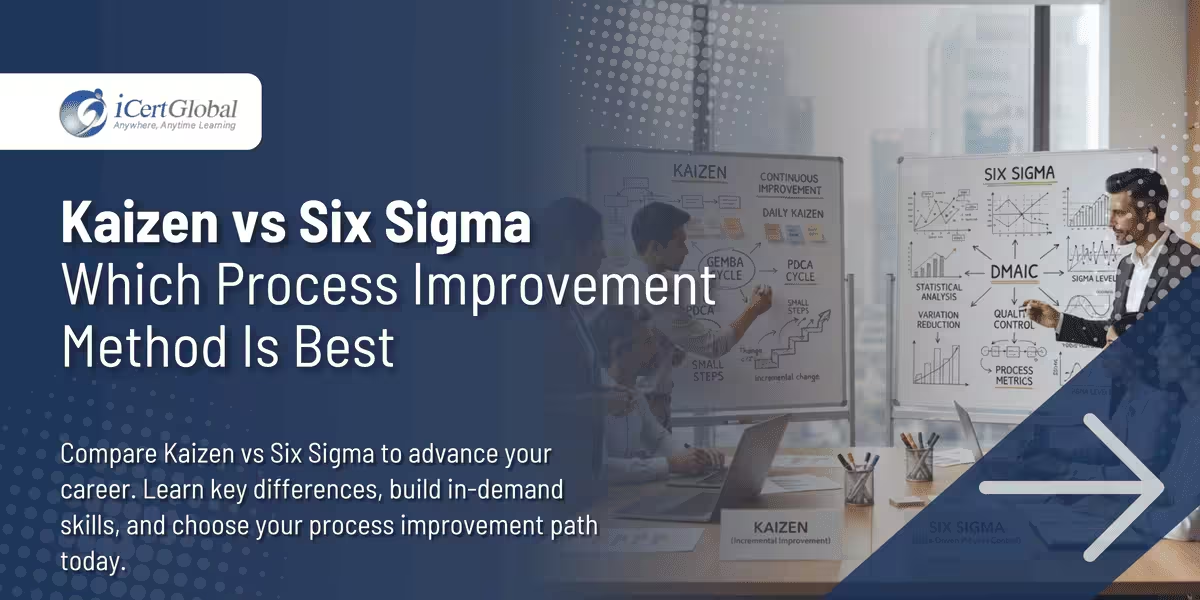
Kaizen vs Six Sigma Which Process Improvement Method
Compare Kaizen vs Six Sigma to advance your career. Learn key differences, build in-demand skills, and choose your...
Six Sigma vs TQM: Key Differences Explained
Advance your career by mastering quality management. Discover the key differences between Six Sigma and TQM to choose...