



PMP Certification Overview
Project Management Professional (PMP) certification is issued by PMI . It is trusted by over 1.2 million professionals across 214 countries, making it the best choice for professionals willing to transition into senior project management roles across industries. iCertGlobal’s project management certification helps you understand how projects work in the real-world: engage in practical scenarios and case studies. Learn how to apply predictive, agile, and hybrid project management approaches to lead teams, handle changes , and manage risks in real business environments. Manage scope creep, resolve conflicts, and meet stakeholder expectations with ease - across diverse industries like IT, finance, and healthcare. Boost your PMP exam preparation by learning AI-driven and sustainable project practices.
PMP Certification Quick Facts
Everything you need to know about PMP certification at a glance.
| Fact | Details |
|---|---|
| Issued By | PMI (Project Management Institute) |
| Active Certifications | 1.2 million+ globally |
| Countries Recognized | 214 countries |
| Experience Required | 3–5 years of project leadership |
| Education Required | 35 contact hours |
| Exam Questions | 180 questions |
| Exam Duration | 230 minutes |
| Renewal | 60 PDUs every 3 years |
| Average Salary Increase | +33% globally |
PMP Training Course Highlights
35 PMI Contact Hours
Our course meets PMI's 35-hour educational requirement.
2,000+ Practice Questions
Every question is scenario-based and mirrors the style of the real PMP exam. Each answer includes a full explanation.
Mock Exams
Take 180-question mock exams that include domains like process, people, and business environment.
Live Instructor-Led Sessions
Weekly live classes with a certified PMP instructor. You can ask questions, work through real project scenarios, and get direct feedback on your weak areas.
Lifetime Course Access
Once enrolled, your access never expires. This is also useful for your 60-PDU renewal every three years.
PMI Application Support
We review your experience documentation before you submit it to PMI.
If you are wondering how to jumpstart your PMP exam preparation—and whether you can realistically balance it with your full-time job—you have come to the right place. This comprehensive, mentor-guided PMP® Certification Course bridges the gap between busy professionals and exam success. You will gain direct, regular access to industry experts to clear your doubts, alongside a curated suite of premium learning materials engineered to help you pass the PMP exam on your very first attempt.
About the PMP Certification Training
The Project Management Professional (PMP)® credential is the gold standard for project managers globally. Our industry-leading program combines traditional methodologies with cutting-edge advancements, featuring specialized AI in Project Management modules. You will discover how AI-powered tools are actively transforming modern workflows, from predictive planning and automated risk analysis to data-driven decision-making. To round out your practical toolkit, you will receive a brand-new PM Toolkit featuring 47 customizable Project Management Templates, equipping you to step into your next meeting as an advanced, high-performing project leader.
Why PMP Course is Ranked #1 by Professionals
We provide the complete ecosystem—expertise, elite resources, and continuous coaching—so you can face the exam with absolute confidence.- 36 Contact Hours of Live, Instructor-Led Sessions: Learn from global experts with decades of hands-on experience in guaranteed-to-run interactive workshops that build a rock-solid practical foundation.
- Complimentary 35-Hour Self-Paced Masterclass: Access premium on-demand videos from a project management leader to fulfill your extra contact hours at your own pace.
- Step-by-Step 5-Week Study Plan: Stop guessing what to study next. Follow a meticulously structured, mentor-led roadmap with weekly touchpoints to keep your preparation perfectly on track.
- Regular Doubt-Clearing Sessions: You are never left to figure things out alone. Join live Q&A sessions throughout your preparation journey to break down complex topics.
- First-Attempt Success Plan: Apply for your exam with total peace of mind. Your mentor will personally review your progress and endorse your readiness, targeting an "Above Target" score.
- 180-Day Grand Pass for Refresher Courses: Need to revisit a concept? Our Grand Pass allows you to rejoin any live workshop as many times as you like for a full six months.
Your career progression doesn’t stop when the exam ends. We accelerate your marketability with an AI-powered resume builder, a professional LinkedIn profile review, and direct access to a curated board of over 1,500 active job listings.
Note:Our curriculum is fully aligned with the latest PMP exam objectives and the 8th Edition of the PMBOK® Guide. As a Premier Authorized Training Partner (ATP) of PMI®, we deliver the highest standard of official education.
Key Skills You Will Master Project management is a multi-faceted discipline. This training focuses on the core technical and soft skills required to lead large-scale, complex projects:- Leadership & Empathy: Learn to delegate effectively, motivate diverse teams, and foster cross-functional collaboration.
- Advanced Planning: Master scheduling techniques and utilize core tools like Gantt charts and network diagrams to build airtight timelines.
- Proactive Risk Management: Develop rigorous contingency plans and risk-response strategies to safeguard your projects.
- Predictive Budgeting: Control costs, forecast expenditures, and manage financial resources within strict constraints.
- Quality Management: Implement quality assurance and control techniques to ensure project deliverables satisfy every stakeholder.
- Stakeholder Engagement: Balance technical execution with the soft skills needed to manage relationships and maintain transparent communication.
- Resource Optimization: Efficiently allocate human resources, materials, and capital to maximize productivity.
- Agile & Scrum Facilitation: Learn to run seamless Sprint Reviews and Retrospectives, driving continuous team improvement.
- Incremental Value Delivery: Structure iterative workflows to gather early feedback, pivot smoothly, and deliver value at every milestone.
Unlock Exclusive PMP Exam Voucher Savings!
As a PMI Authorized Training Partner, we pass our institutional advantages directly on to you.- Special ATP Discount: Enjoy unmatched savings on your official PMP exam voucher by purchasing it directly through our program.
- Pro Tip: Before you finalize your enrollment, connect with our dedicated advisory team to lock in the absolute lowest market rate available for your exam voucher. Don't leave your certification to chance. Contact our team today, secure your savings, and take the definitive step toward PMP success!
- 10 Million+ Job Openings: The global market is projected to require over 10 million new project management roles by 2030.
- 33% Growth by 2027: The Project Management Institute (PMI) anticipates a massive 33% increase in project-oriented positions globally, requiring nearly 90 million skilled professionals to fill the talent gap.
- The AI Revolution: Modern project environments are undergoing a rapid digital transformation. Today’s market highly rewards professionals who understand how to leverage AI automation tools for advanced planning, predictive forecasting, and data-driven risk analysis.
The Surging Demand for PMP® Certified Professionals
The project management profession has evolved from a specialized corporate function into one of the most critical drivers of business success across almost every industry. Organizations worldwide face a continuous wave of complex, high-stakes initiatives, making skilled project leaders more valuable than ever.Corporate PMP Certification Training for Teams
Upskill your teams with globally recognized PMP training.
Train your entire project management team with a customized PMP program designed around your organization's schedule, industry, and learning goals.
If you manage a team of project managers — or if your organization is scaling its PMO — a group PMP training program delivers significantly better results when compared to individual training.
Our corporate PMP certification training includes a dedicated instructor assigned to your team, custom scheduling that works around your business calendar, and a single account manager who handles all enrollment, progress tracking, and reporting. You get visibility into every learner's mock exam performance and completion status in real time.
We work with companies in IT, construction, finance, healthcare, consulting, and manufacturing. Our smallest team programs start at 5 seats; enterprise programs have run for 200+ participants across multiple geographies.

Ready to transform your team?
Get a custom quote for your organization's training needs.
10M+ Job Openings in Project Management By 2030
Demand for PMP Certified Professionals
Average Salary
Min
Average
Max
Hiring Companies
Cognizant
amazon
[S] Sapient
The Wall Street Journal.
SOCIETE GENERALE
ORACLE
Demand
US$ 208 Billion
GDP risk due to potential PM talent shortages by 2027
Average Salary
MinAverageMax
Hiring Companies
amazon
ORACLE
Cognizant
SOCIETE GENERALE
[S] Sapient
The Wall Street Journal.
Demand
High Urgency
Increased agile transformation metrics requiring qualified leadership across tech domains.
Average Salary
MinAverageMax
Hiring Companies
[S] Sapient
SOCIETE GENERALE
ORACLE
Cognizant
The Wall Street Journal.
amazon
Demand
Global Deficit
PMO optimization processes are seeing structural shortfalls across EU and APAC enterprise sectors.
Average Salary
MinAverageMax
Hiring Companies
The Wall Street Journal.
Cognizant
amazon
ORACLE
SOCIETE GENERALE
[S] Sapient
Demand
Elite Status
Executive infrastructure positions demand extensive oversight metrics and verified portfolios.
Average Salary
Hiring Companies
Demand
US$ 208 Billion
GDP risk due to potential PM talent shortages by 2027
Average Salary
Hiring Companies
Demand
High Urgency
Increased agile transformation metrics requiring qualified leadership across tech domains.
Average Salary
Hiring Companies
Demand
Global Deficit
PMO optimization processes are seeing structural shortfalls across EU and APAC enterprise sectors.
Average Salary
Hiring Companies
Demand
Elite Status
Executive infrastructure positions demand extensive oversight metrics and verified portfolios.
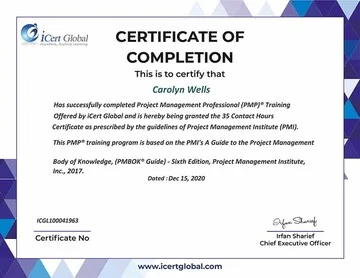
Professional PMP Certificate
Professional PMP Certificate
Validate your project management skills with an industry-recognized certification
Upon successful completion of our PMP course, you will receive an official PMI-authorized certificate that is relevant across diverse industries. This certification validates your knowledge of modern project management practices, leadership skills, Agile and hybrid delivery approaches, and your ability to manage projects successfully in dynamic business environments.
Earning this credential demonstrates your commitment to continuous learning and career growth in project management.
- PMI Continuing Professional Development Units (PDUs)
- LinkedIn Digital Badge
- Enhanced Career Opportunities
- Lifetime Access to Updated Learning Materials
- Exam Preparation Support
- Industry-Relevant Skills
Upcoming PMP® Certification Training schedule


How Much Does PMP Certification Cost?
Explore PMP exam, training, and certification costs quickly.
Core Costs
| Cost Item | PMI Member Cost | Non-Member Cost | Notes |
|---|---|---|---|
| PMP Exam Fee | $425 | $675 | Paid to PMI when scheduling your exam |
| PMI Annual Membership | $164 | - | Optional, but saves $150 on exam fee |
| PMP Training Course | $2499 | $2499 | Current discounted training price |
| PMBOK® Guide | Included | $60+ | Free digital download with PMI membership |
| Practice Materials | Included | Included | Included with training |
Optional/Retake Costs
| Cost Item | PMI Member Cost | Non-Member Cost |
|---|---|---|
| Exam Retake Fee | $275 | $375 |
| PDU Renewal (Every 3 Years) | $60–$250 | $60–$250 |
| Additional Study Materials | $0–$100 | $0–$100 |
| PMP Certification Renewal | $60 | $150 |
PMP Exam Fee by Region
| Region | Member Fee | Non-Member Fee | Notes |
|---|---|---|---|
| United States | $584 | $675 | |
| United Kingdom | $584 | $675 | |
| India | ₹26,412 + tax | ₹53,475 + tax | Membership fees: ₹11,160 + tax |
| UAE / GCC | $584 | $675 | |
| Australia | $584 | $675 | |
| Canada | $584 | $675 |
Benefits of the PMP Certification Training
Key Benefits of PMP Certification Training for Professionals and Organizations
Individual Benefits
Organizational Benefits
Skills You Will Gain In Our PMP Training Program
Breaking down project work
Dividing a large project into smaller, manageable tasks makes execution easier. It helps teams clearly understand responsibilities and deliverables.
Estimating project costs
Project cost estimation involves predicting the financial resources required to complete a project.
Planning resources effectively
Resource planning ensures the right people, tools, and materials are available when needed.
Managing budgets
Budget management tracks project spending and helps control expenses.
Developing Gantt charts
Gantt charts help teams monitor progress, dependencies, and deadlines efficiently.
Creating project timelines
Project timelines define when activities start and finish.
Scheduling tasks and activities
Scheduling organizes tasks in a logical sequence based on priorities and dependencies.
Managing risks and issues
Risk management identifies potential problems before they occur.
Communicating with stakeholders
Stakeholder communication keeps everyone informed about progress and changes.
Understanding project governance
Project governance establishes rules, roles, and decision-making structures.
Using Agile and hybrid methods
Agile and hybrid approaches allow teams to adapt quickly while maintaining project control.
Delivering value through projects
Successful projects focus on delivering value. The objective is to ensure the project meets stakeholder expectations and organizational objectives.
Who Should Enroll for PMP Certification
Project Leaders
Mid-Level Project Managers
Project Analysts
Product Managers
Senior Project Managers
Project Coordinators
Program Managers
You can enrol for the PMP certification program to sharpen your project management skills and lead projects across diverse industries. The training helps professionals develop skills required to manage project scope, cost, and schedule. Most importantly, it enables professionals to deliver project outcomes that meet the stakeholder requirements and align with organizational goals.
PMP Certification Training Program Roadmap


Why Get PMP-Certified?
Career Opportunities
Get an opportunity to work with global teams and international projects across different countries and industries.
Get Job-Ready
A sound knowledge of AI, agile practices, and sustainability helps you navigate the evolving landscape of project management.
Master Project Management Skills
Apply hybrid, agile, and predictive methodologies in real-world scenarios. Deliver value consistently by managing project elements like scope, cost, risk, stakeholders, and time.
Lead with Confidence
Collaborate with cross-functional teams, adapt to changing project requirements, and build the ability to cope with real-world challenges.
Earn a Higher Salary
Project Managers with a Project Management certification earn a better salary than their non-certified peers. This important credential also offers them an opportunity to transition to senior and leadership positions.
PMP® certification Eligibility and Pre-requisites
Bachelor’s Degree or Higher
High School Diploma or Associate Degree
GAC-Accredited Bachelor’s Degree
Meet the Instructors
Kathy Rogers
Zahn Patin
Rufus Alexander, M.B.A., PM
Tim McDermott, PMP
Norman Wilson, PMP, PMI-ACP
Kathy Rogers
Zahn Patin
Rufus Alexander, M.B.A., PM
Tim McDermott, PMP
Norman Wilson, PMP, PMI-ACP
Kathy Rogers
Zahn Patin
Rufus Alexander, M.B.A., PM
Tim McDermott, PMP
Norman Wilson, PMP, PMI-ACP
Course Modules & Curriculum
Lesson 1: Leading and Managing Teams
- Understand the importance of effective leadership in successful project delivery
- Learn different leadership styles, including directive and collaborative approaches
- Apply leadership techniques to diverse and cross-functional team environments
- Develop skills to set clear goals and establish a shared vision
- Foster a culture of trust, collaboration, and team engagement
- Enhance overall team performance and productivity
Lesson 2: Conflict Management and Negotiation
- Understand why conflict is inevitable in project teams and its impact on outcomes
- Learn to identify the source and stage of conflict
- Analyze the context and underlying causes of team disagreements
- Apply effective conflict resolution techniques and strategies
- Develop skills to negotiate project agreements confidently
- Build consensus among stakeholders in diverse project scenarios
- Strengthen communication to maintain team alignment and productivity
Lesson 3: Empowering and Developing Team Members
- Understand the role of a project manager in empowering team members
- Learn how to evaluate and appraise team performance effectively
- Provide constructive feedback to support continuous improvement
- Foster a culture of learning, growth, and accountability
- Identify skill gaps and training needs within the team
- Enable development through resources, coaching, and support
- Enhance overall team capability and long-term performance
Lesson 4: Emotional Intelligence and Team Engagement
- Understand the role of emotional intelligence (EQ) in managing team dynamics
- Learn how to assess the emotional needs of team members and stakeholders
- Apply EQ to adapt communication and leadership styles effectively
- Improve team engagement and collaboration through emotional awareness
- Build stronger relationships and stakeholder trust
- Enable smoother project execution by managing interpersonal dynamics
Lesson 1: Planning and Managing Project Scope
- Understand the importance of effective scope management
- Learn to define and control project scope
- Develop a Work Breakdown Structure (WBS)
- Monitor project progress to stay on track
- Prevent and manage scope creep
- Prioritize and validate requirements aligned with stakeholder expectations
Lesson 2: Scheduling and Resource Management
- Learn to estimate task durations accurately
- Manage task dependencies and sequencing
- Create realistic and achievable project schedules
- Apply resource allocation techniques effectively
- Understand budgeting strategies for optimal resource use
- Ensure efficient resource utilization throughout the project lifecycle
Lesson 3: Quality Management and Risk Control
- Define and maintain quality standards for project deliverables
- Monitor performance and drive continuous improvement
- Understand the risk management process
- Identify, assess, and prioritize project risks
- Implement risk mitigation strategies to reduce impact
Lesson 4: Procurement and Communication Management
- Manage procurement requirements and vendor selection
- Learn to negotiate contracts and manage suppliers
- Monitor supplier performance and deliverables
- Define stakeholder communication needs and strategies
- Establish clear communication channels
- Ensure timely and accurate information flow
Lesson 5: Change Management and Integration
- Understand the impact of change in project environments
- Manage changes to scope, schedule, and resources
- Apply structured change management strategies
- Integrate changes while maintaining project alignment
- Ensure stakeholder expectations and project goals remain aligned
Lesson 1: Compliance and Regulatory Requirements
- Understand the importance of compliance in project management
- Identify regulatory and legal requirements impacting projects
- Learn methods to address compliance-related challenges
- Assess the risks and consequences of non-compliance
- Ensure alignment with organizational and legal standards
Lesson 2: Evaluating Project Benefits and Value Delivery
- Define and measure project benefits and success criteria
- Focus on value-driven project delivery
- Track and ensure value realization throughout the lifecycle
- Communicate project value effectively to stakeholders
- Align outcomes with organizational goals and objectives
Lesson 3: Managing External Business Environment Changes
- Monitor external factors such as regulations, technology, and market trends
- Assess the impact of external changes on project scope and execution
- Adapt project plans to minimize risks and disruptions
- Identify and leverage new opportunities from changing environments
- Maintain project alignment in a dynamic business landscape
Lesson 4: Supporting Organizational Change
- Assess organizational culture and change readiness
- Understand how internal changes impact project outcomes
- Apply strategies to manage organizational change effectively
- Align project objectives with evolving business needs
- Ensure smooth integration of change within project execution
Lesson 1: Understanding Agile Methodologies
- Understand the core principles and values of Agile project management
- Compare Agile vs traditional (predictive) approaches
- Explore popular Agile frameworks like Scrum and Kanban
- Learn when to apply Agile methodologies in different project environments
- Emphasize flexibility, collaboration, and iterative delivery
- Adapt to changing requirements and continuous feedback
Lesson 2: Hybrid Project Management Approaches
- Understand the concept of hybrid project management
- Combine predictive (traditional) and Agile (adaptive) approaches
- Learn how to balance structure with flexibility
- Apply hybrid strategies to real-world project scenarios
- Improve project outcomes through customized methodology selection
- Adapt approaches based on project complexity and stakeholder needs
Lesson 1: Defining Project Charter and Scope
- Understand the importance of the project charter as a foundational document
- Learn to define project goals, objectives, and deliverables
- Develop and manage project scope effectively
- Use Work Breakdown Structure (WBS) to break down scope
- Ensure deliverables are clearly defined and achievable
- Maintain alignment with stakeholder expectations
Lesson 2: Risk and Resource Planning
- Identify and assess project risks proactively
- Develop effective risk mitigation strategies
- Plan and allocate resources efficiently
- Balance time, cost, and resource constraints
- Ensure projects stay on schedule and within budget
- Optimize resource utilization for successful project delivery
Lesson 1: Executing Project Plans
- Understand how to execute project plans effectively
- Manage people, resources, and day-to-day activities
- Ensure alignment with project goals and objectives
- Handle project constraints such as scope, time, and cost
- Manage and meet stakeholder expectations
- Maintain smooth project execution and coordination
Lesson 2: Monitoring and Controlling Project Performance
- Track project progress using key metrics and performance indicators (KPIs)
- Monitor alignment with project goals and timelines
- Identify deviations and performance gaps
- Take corrective and preventive actions when required
- Ensure continuous performance control and improvement
- Keep the project on track for successful delivery
Lesson 1: Project Closure and Handover
- Understand the importance of formal project closure
- Validate that all deliverables meet defined requirements
- Ensure successful handover to clients and stakeholders
- Conduct a final project review and evaluation
- Document lessons learned for future reference
- Confirm completion of all project objectives and deliverables
Lesson 2: Knowledge Transfer and Lessons Learned
- Capture and document key lessons learned during the project
- Share insights with relevant stakeholders and teams
- Enable effective knowledge transfer within the organization
- Support continuous improvement in project practices
- Strengthen future project outcomes through experience-based learning
- Build a culture of learning and knowledge sharing
Online PMP Training: 3 Ways to Get PMP Certified Online
Our Certified Training Experts are available across the globe.
Online PMP training has become a popular and effective way to prepare for the PMP exam. The best programs now offer flexible study options, expert guidance, practice exams, and strong exam support. But every learner is different. Some people prefer live classes, some want to study at their own pace, and others need a fast-track option. Here are the three main ways to complete your PMP certification training online.
Duration: 4 Days
1. Live Online PMP Training
Live online training gives you scheduled classes with a PMP-certified instructor. You can ask questions, discuss real project examples, review case studies, and get feedback during the course.
Most live sessions are also recorded, so you can watch them again later if you miss anything.
Best for:
People who learn better with instructor support, live discussion, and a fixed study schedule.
2. Self-Paced Online PMP Training
Self-paced PMP training lets you complete the required 35 hours of course content on your own schedule. You can watch videos, review study materials, complete practice questions, and take mock exams whenever you have time.
This option is ideal for busy professionals who cannot attend fixed class sessions.
Best for:
Self-motivated learners who want full flexibility.
3. Intensive PMP Bootcamp
A PMP bootcamp is a short, focused training program completed in 4–5 days. It covers the 35 required training hours quickly and focuses heavily on exam strategy, key concepts, and practice questions.
This format is intense, so it is best for people who already understand project management basics.
Best for:
Professionals who already have project management experience and want fast, structured exam preparation.
PMP Certification & Exam FAQ
Option 1:
4-year bachelor’s degree
36 months of project management experience
35 hours of project management training
Option 2:
High school diploma or associate degree
60 months of project management experience
35 hours of project management training
Today, companies don't just look for professionals who can manage tasks - they want project managers who can lead teams, handle risks, make strategic decisions, and deliver successful outcomes. That's why many leading organizations like Amazon, Microsoft, Google, IBM, Accenture, and Deloitte value PMP-certified professionals for project management and leadership roles.
A PMP certification helps your resume stand out, gives employers confidence in your project management skills, and can open the door to better job opportunities, leadership positions, and higher salaries. It also demonstrates your commitment to professional growth and your ability to manage projects using globally recognized best practices.
In many global markets, PMP professionals can earn between $90,000 and $150,000 annually depending on experience.
Live online instructor-led training
Classroom training
Self-paced online courses
Many professionals prefer online training because it offers flexibility and global access.
Customer Testimonials
Exceptional PMP Training Experience with iCert Global I recently completed the PMP training by iCert Global, and I must say it was an outstanding experience. The instructor demonstrated a deep understanding of project management principles and brought real-world experience to the table. The training material's provided were comprehensive and well-organized, offering valuable insights and practical tips. I would highly recommend iCert Global to anyone looking for professional PMP Training..

John Anderson
iCert Global provided a great learning experience with clear, well organised courses. The trainers were knowledgeable, and the support team was responsive to all my questions. The study material was comprehensive, which helped me pass my certification exam with ease. Highly recommended for anyone looking to get certified.
James Walsh
iCert Global is the best Certificate Training Organization. you will get good instructor and they will improve leaning sills and give the real time experience examples due to that you will get pass in first try.
Andy Moran
The course content, exam prep questions, interactive Q&A, and real-life examples made attending this PMP Project Management training class worth my time and money. The support from iCert Global was exceptional and I would like to thank them for accepting my request of meeting the trainer post the session for clearing my doubts.
Tim Malone
I had a good learning experience with icert Global and it had been an amazing development journey. Actually, I accidentally bumped into iCert Global while searching for an online course for preparing my PMP examination. With positive reviews all over the internet and quick responses to my questions, I was flabbergasted enough to sign-up immediately. The instructor-led PMP preparatory course helped me both offline and online preparations. All the high-quality materials written in simple layman language was enough to grasp the gist of various topics. The instructors were very knowledgeable as they imparted not only their wealth of experiences but also real life examples. Thanks a lot iCert Global for imbibing this great learning experience.
Jason Walter
Thank you for your great course, great support, rapid response and excellent service.
Hoda Alavi
My trainer made the materials relatable and easy to understand. It was fun being in class everyday.
Cassandra Corn
Amazing trainer who was very supportive.

Shanna Pilgrim
Trainer was well versed in the subject matter and got the impression the gentleman was professional and educated within standards and procedures for PMI.
Anthony Zamora
The Training was good and customer service was perfect.
Maka Diakhate
Trainer was knowledgeable and lesson's pace was just right.

Roger Gonzales
Trainer (Bruce) was very excellent in delivery and presentation. He provided me with all the tools required to be successful in the PMP exams with lots of quiz questions on all topics reviewed.
Bashiru Ojibara
The trainer, Emad was top notch and very knowledgeable. He is up to date with all current versions and is great in 1:1 Training.

Jonathan Obien
Thank you for your great course, great support, rapid response and excellent service

Hoda Alavi
Marc had very good knowledge and he was able to explain the material and provide guidance to get ready for the test.

Roque Montesino
Excellent Course. Zahn was a great instructor and the course material definitely will help me pass the PMP Exam

Jared Nelson
Great teacher, went out of his way in every possible aspect.
Radiah Sims
Customer service provided by Robin was great as he was very responsive and the trainer, John, was very good at relating the content to my industry.

Jason D Niebauer
Course & Support
PMP Training in Other Cities
Related Blogs
Stay updated with the latest insights and trends in your field
The Future of Project Management Certifications After PMP
Earned your PMP certificate? Discover the next advanced credentials to accelerate your career, master specialized skills, and boost...
How Long Does PMP Certification Take? Data from
Discover how long it takes to become PMP certified. We analyzed data from 500+ learners to help you...
Optimizing Project Scheduling AI for Agile and Waterfall
Master project scheduling AI for Agile and Waterfall frameworks to boost your career. Learn how to optimize your...
.webp)
Key PMI CPMAI Benefits for Your AI Project
Unlock key PMI CPMAI benefits to lead AI projects with confidence, boost your earning potential, and scale your...
.webp)
How Many Phases Are There in the CPMAI
Learn the six phases of the CPMAI methodology, understand how each stage supports successful AI projects, and discover...
CPMAI Salary: How Much Do PMI-CPMAI Certified Professionals
Discover how a PMI-CPMAI certification impacts your salary. Learn potential earnings, career paths, and ROI for AI project...
AI Project Manager Career Path: Skills, Certifications, and
Advance your career as an AI Project Manager. Discover the essential skills, top certifications, and strategic pathways to...
AI for Project Management: Why Tomorrow's Best Project
Master AI for project management to future-proof your career. Learn high-value skills, boost your efficiency, and lead modern,...
What Makes the CPMAI v7 Certification Different From
Compare the CPMAI v7 certification to other AI credentials. Learn how this methodology-based training advances your project management...
.webp)
Which CPMAI Phase Focuses on Application Development?
Master the CPMAI methodology. Learn which phase focuses on application development and deployment to accelerate your AI project...