PMP Certification Training Overview

Aligned with the updated PMP exam, launched on July 9, 2026, and the PMBOK® Guide – Eighth Edition, our training helps you tackle real-world project challenges. Through practical case studies, role-plays, and simulations, you’ll learn to apply predictive, agile, and hybrid project management approaches. Build the practical skills to lead teams, manage change and risk, control scope creep, resolve conflicts, and meet stakeholder expectations across industries such as IT, finance, and healthcare. Prepare for the PMP exam with full-length mock exams based on the current 2026 Examination Content Outline (ECO).

PMP Training Course Highlights

★

35 PMI Contact Hours

35 contact hours of live, instructor-led training that meets PMI's education requirement.

★

2,000+ Practice Questions

2,000+ practice questions, each with a full explanation, mapped to the 2026 ECO.

★

Get Exam-Ready

Take full-length mock exams covering People, Process, and Business Environment at the current weightings.

★

Exam Guidance

Prepare for the PMP exam 2026 with a structured 5-week study plan, weekly instructor touchpoints, and regular live doubt-clearing/Q&A sessions.

★

Application Support

Our experts review your experience documentation before submission.

★

Access to PM Templates

15+ ready-to-use PM templates(charter, RAID log, risk register, stakeholder map, schedule, and more).

If you are wondering how to jump-start your PMP exam preparation—and whether you can realistically balance it with your full-time job—you have come to the right place. This comprehensive, mentor-guided PMP® Certification Course bridges the gap between busy professionals and exam success. You will gain direct, regular access to industry experts to clear your doubts, alongside a curated suite of premium learning materials engineered to help you pass the PMP exam on your very first attempt.

What is included in our PMP Training course?

We provide the complete ecosystem—expertise, elite resources, and continuous coaching—so you can face the exam with absolute confidence.
  • 35 Contact Hours of Online Live, or Instructor-Led Classroom Sessions: Learn from global experts with decades of hands-on experience in guaranteed-to-run interactive workshops that build a rock-solid practical foundation.
  • Complimentary Self-Paced eLearning: Access our on-demand videos anytime within the next 12 months to fulfil your extra contact hours at your own pace.
  • Step-by-Step 5-Week Study Plan: Stop guessing what to study next. Follow a meticulously structured, mentor-led roadmap with weekly touchpoints to keep your preparation perfectly on track.
  • First-Attempt Success Plan: Apply for your exam with total peace of mind. Your mentor will personally review your progress and endorse your readiness, targeting an "Above Target" score.

Why the timing matters: the 2026 PMP exam has changed

If you are preparing now, you are preparing for a different exam than anyone who tested before 9 July 2026. Most study material still reflects the old outline. This course is built to the current one.

What changed with the July 2026 update:

  • Domain weightings rebalanced. The three domains stay the same, but their share shifted — People 33%, Process 41%, Business Environment 26%. Business Environment roughly tripled (it was 8%), so strategy, compliance, and organizational context now carry real weight. (Source: PMI, 2026 ECO.)
  • New testable content: AI in project management, sustainability/ESG, and value delivery moved from “nice to know” to examinable.
  • New question types: case-study sets, drag-and-drop, matching, point-and-click, and graphic interpretation, alongside multiple choice.
  • Format: 180 questions (170 scored + 10 unscored), 240 minutes, two optional 10-minute breaks.
  • Unchanged: eligibility requirements and the total question count.

Our curriculum, mocks, and question bank are mapped to the 2026 ECO and PMBOK® 8th Edition — so you study the exam you will actually sit.

Upcoming Schedule

Format
Enroll in This Batch
MTWTFSS
Selected batch Other batches: click a highlighted date

PMP Certification Quick Facts

Fact Details
Issued By PMI (Project Management Institute)
Active Certifications 1.7 million+ globally
Countries Recognized 200+ countries
Experience Required 24 / 36 / 48 / 60 months within the last 10 years, depending on education
Education Required 35 hours of project management education or training, or an active CAPM certification
Exam Questions 180 questions
Exam Duration 240 minutes
Renewal 60 PDUs every 3 years
Average Salary Difference 17% higher median salary globally (PMI Salary Survey, 14th Edition, 2025)

Source: Project Management Institute (PMI) – Official Certifications Page | PMI 2023 Annual Report | Last Verified : 29 Oct 2026

Why Get PMP-Certified?

Career Opportunities

Get an opportunity to work with global teams and international projects across different countries and industries.

Get Job-Ready

A sound knowledge of AI, agile practices, and sustainability helps you navigate the evolving landscape of project management.

Master Project Management Skills

Apply hybrid, agile, and predictive methodologies in real-world scenarios. Deliver value consistently by managing project elements like scope, cost, risk, stakeholders, and time.

Lead with Confidence

Collaborate with cross-functional teams, adapt to changing project requirements, and build the ability to cope with real-world challenges.

Earn a Higher Salary

Project Managers with a Project Management certification earn a better salary than their non-certified peers. This important credential also offers them an opportunity to transition to senior and leadership positions.

Who Should Enroll for PMP Certification

This certification training is ideal for:

Project Leaders
Mid-Level Project Managers
Project Analysts
Product Managers
Senior Project Managers
Project Coordinators
Program Managers

You can enrol for the PMP certification program to sharpen your project management skills and lead projects across diverse industries. The training helps professionals develop skills required to manage project scope, cost, and schedule. Most importantly, it enables professionals to deliver project outcomes that meet the stakeholder requirements and align with organizational goals.

PMP® certification Eligibility and Pre-requisites

The PMP certification is respected globally because it provides a standardized benchmark for professional project management expertise. PMI has established clear and rigorous requirements that validate the experience, knowledge, and skills of professionals seeking to advance their project management careers. The PMP certification is recognized worldwide as a leading credential that demonstrates a professional’s ability to manage projects effectively and deliver successful outcomes across industries.

Bachelor’s Degree or Higher

  • ✓ Bachelor’s degree (or global equivalent)
  • ✓ 36 months of project management experience within the last 10 years
  • ✓ 35 hours of formal project management education or CAPM® certification

High School Diploma or Associate Degree

  • ✓ High school diploma, associate degree, or global equivalent
  • ✓ 60 months of project management experience within the last 10 years
  • ✓ 35 hours of formal project management education or CAPM® certification

GAC-Accredited Bachelor’s Degree

  • ✓ A degree from a PMI GAC-accredited program
  • ✓ 24 months of project management experience
  • ✓ GAC coursework may count toward the 35-hour project management training requirement.
  • ✓ Candidates with an active CAPM certification do not need additional 35-hour training.
60-second check

Are you eligible to sit the PMP® exam?

Answer four quick questions to see which PMI eligibility path fits you.

Experience needed, by education

  • 24monthsGAC-accredited bachelor's or master's
  • 36monthsFour-year bachelor's degree
  • 60monthsHigh school or associate degree

Experience means leading or directing projects, within the last 8 years. Every path also needs 35 hours of PM education, or the CAPM® certification.

Question 1 of 4

      Email me my eligibility path & application checklist

      Result sent

      Your eligibility path is in your inbox.

      Indicative check based on published PMI criteria. PMI makes the final decision when you apply.

      Skills You Will Gain In Our PMP Training Program

      ✓
      Leadership & team development:
      Motivate and lead cross-functional teams with confidence.
      ✓
      Planning scheduling:
      Learn how to create Gantt charts, network diagrams, critical path, and realistic timelines.
      ✓
      Risk management:
      Develop the skills necessary to identify, quantify, and plan responses to protect delivery.
      ✓
      Cost & budget control:
      Learn how to estimate, forecast, and manage financial constraints.
      ✓
      Quality management:
      Implement quality assurance and control practices that meet stakeholder expectations.
      ✓
      Stakeholder engagement & communication:
      Manage expectations, maintain clear communication, and keep everyone aligned toward shared project goals.
      ✓
      Agile & hybrid delivery:
      Learn how to run sprint reviews and retrospectives; tailor predictive, agile, and hybrid approaches.
      ✓
      Value delivery, AI, and sustainability:
      Apply the newly weighted 2026 themes to real-world workflows that support sustainable project outcomes.

      PMP Course Modules

      MODULE - 1

      Module 1: Introduction to Project Management

      LESSON 1

      Lesson 1: Overview of Project Management

      • Understand project management as a discipline for leading teams to achieve specific goals within time and budget
      • Learn the definition of a project and key project management concepts
      • Explore the project lifecycle and its core phases
      • Recognize the importance of PMP® certification in career growth
      • Understand how the PMP® exam validates your ability to manage complex, real-world projects effectively
      LESSON 2

      Lesson 2: The PMP Exam Content Outline

      • Understand the three key PMP® exam domains: People, Process, and Business Environment
      • Learn the exam structure and question distribution across domains
      • Explore domain weightage:
        • People – 33%
        • Process – 41%
        • Business Environment – 26%
      • Gain insights into tasks and enablers within each domain
      • Prepare for questions covering predictive, agile, and hybrid methodologies
      • Develop strategies to approach different types of exam scenarios effectively
      MODULE - 2

      Module 2: Domain 1 - People

      LESSON 1

      Lesson 1: Leading and Managing Teams

      • Understand the importance of effective leadership in successful project delivery
      • Learn different leadership styles, including directive and collaborative approaches
      • Apply leadership techniques to diverse and cross-functional team environments
      • Develop skills to set clear goals and establish a shared vision
      • Foster a culture of trust, collaboration, and team engagement
      • Enhance overall team performance and productivity
      LESSON 2

      Lesson 2: Conflict Management and Negotiation

      • Understand why conflict is inevitable in project teams and its impact on outcomes
      • Learn to identify the source and stage of conflict
      • Analyze the context and underlying causes of team disagreements
      • Apply effective conflict resolution techniques and strategies
      • Develop skills to negotiate project agreements confidently
      • Build consensus among stakeholders in diverse project scenarios
      • Strengthen communication to maintain team alignment and productivity
      LESSON 3

      Lesson 3: Empowering and Developing Team Members

      • Understand the role of a project manager in empowering team members
      • Learn how to evaluate and appraise team performance effectively
      • Provide constructive feedback to support continuous improvement
      • Foster a culture of learning, growth, and accountability
      • Identify skill gaps and training needs within the team
      • Enable development through resources, coaching, and support
      • Enhance overall team capability and long-term performance
      LESSON 4

      Lesson 4: Emotional Intelligence and Team Engagement

      • Understand the role of emotional intelligence (EQ) in managing team dynamics
      • Learn how to assess the emotional needs of team members and stakeholders
      • Apply EQ to adapt communication and leadership styles effectively
      • Improve team engagement and collaboration through emotional awareness
      • Build stronger relationships and stakeholder trust
      • Enable smoother project execution by managing interpersonal dynamics
      MODULE - 3

      Module 3: Domain 2 - Process

      LESSON 1

      Lesson 1: Planning and Managing Project Scope

      • Understand the importance of effective scope management
      • Learn to define and control project scope
      • Develop a Work Breakdown Structure (WBS)
      • Monitor project progress to stay on track
      • Prevent and manage scope creep
      • Prioritize and validate requirements aligned with stakeholder expectations
      LESSON 2

      Lesson 2: Scheduling and Resource Management

      • Learn to estimate task durations accurately
      • Manage task dependencies and sequencing
      • Create realistic and achievable project schedules
      • Apply resource allocation techniques effectively
      • Understand budgeting strategies for optimal resource use
      • Ensure efficient resource utilization throughout the project lifecycle
      LESSON 3

      Lesson 3: Quality Management and Risk Control

      • Define and maintain quality standards for project deliverables
      • Monitor performance and drive continuous improvement
      • Understand the risk management process
      • Identify, assess, and prioritize project risks
      • Implement risk mitigation strategies to reduce impact
      LESSON 4

      Lesson 4: Procurement and Communication Management

      • Manage procurement requirements and vendor selection
      • Learn to negotiate contracts and manage suppliers
      • Monitor supplier performance and deliverables
      • Define stakeholder communication needs and strategies
      • Establish clear communication channels
      • Ensure timely and accurate information flow
      LESSON 5

      Lesson 5: Change Management and Integration

      • Understand the impact of change in project environments
      • Manage changes to scope, schedule, and resources
      • Apply structured change management strategies
      • Integrate changes while maintaining project alignment
      • Ensure stakeholder expectations and project goals remain aligned
      MODULE - 4

      Module 4: Domain 3 - Business Environment

      LESSON 1

      Lesson 1: Compliance and Regulatory Requirements

      • Understand the importance of compliance in project management
      • Identify regulatory and legal requirements impacting projects
      • Learn methods to address compliance-related challenges
      • Assess the risks and consequences of non-compliance
      • Ensure alignment with organizational and legal standards
      LESSON 2

      Lesson 2: Evaluating Project Benefits and Value Delivery

      • Define and measure project benefits and success criteria
      • Focus on value-driven project delivery
      • Track and ensure value realization throughout the lifecycle
      • Communicate project value effectively to stakeholders
      • Align outcomes with organizational goals and objectives
      LESSON 3

      Lesson 3: Managing External Business Environment Changes

      • Monitor external factors such as regulations, technology, and market trends
      • Assess the impact of external changes on project scope and execution
      • Adapt project plans to minimize risks and disruptions
      • Identify and leverage new opportunities from changing environments
      • Maintain project alignment in a dynamic business landscape
      LESSON 4

      Lesson 4: Supporting Organizational Change

      • Assess organizational culture and change readiness
      • Understand how internal changes impact project outcomes
      • Apply strategies to manage organizational change effectively
      • Align project objectives with evolving business needs
      • Ensure smooth integration of change within project execution
      MODULE - 5

      Module 5: Agile and Hybrid Project Management

      LESSON 1

      Lesson 1: Understanding Agile Methodologies

      • Understand the core principles and values of Agile project management
      • Compare Agile vs traditional (predictive) approaches
      • Explore popular Agile frameworks like Scrum and Kanban
      • Learn when to apply Agile methodologies in different project environments
      • Emphasize flexibility, collaboration, and iterative delivery
      • Adapt to changing requirements and continuous feedback
      LESSON 2

      Lesson 2: Hybrid Project Management Approaches

      • Understand the concept of hybrid project management
      • Combine predictive (traditional) and Agile (adaptive) approaches
      • Learn how to balance structure with flexibility
      • Apply hybrid strategies to real-world project scenarios
      • Improve project outcomes through customized methodology selection
      • Adapt approaches based on project complexity and stakeholder needs
      MODULE - 6

      Module 6: Project Initiation and Planning

      LESSON 1

      Lesson 1: Defining Project Charter and Scope

      • Understand the importance of the project charter as a foundational document
      • Learn to define project goals, objectives, and deliverables
      • Develop and manage project scope effectively
      • Use Work Breakdown Structure (WBS) to break down scope
      • Ensure deliverables are clearly defined and achievable
      • Maintain alignment with stakeholder expectations
      LESSON 2

      Lesson 2: Risk and Resource Planning

      • Identify and assess project risks proactively
      • Develop effective risk mitigation strategies
      • Plan and allocate resources efficiently
      • Balance time, cost, and resource constraints
      • Ensure projects stay on schedule and within budget
      • Optimize resource utilization for successful project delivery
      MODULE - 7

      Module 7: Project Execution and Monitoring

      LESSON 1

      Lesson 1: Executing Project Plans

      • Understand how to execute project plans effectively
      • Manage people, resources, and day-to-day activities
      • Ensure alignment with project goals and objectives
      • Handle project constraints such as scope, time, and cost
      • Manage and meet stakeholder expectations
      • Maintain smooth project execution and coordination
      LESSON 2

      Lesson 2: Monitoring and Controlling Project Performance

      • Track project progress using key metrics and performance indicators (KPIs)
      • Monitor alignment with project goals and timelines
      • Identify deviations and performance gaps
      • Take corrective and preventive actions when required
      • Ensure continuous performance control and improvement
      • Keep the project on track for successful delivery
      MODULE - 8

      Module 8: Closing the Project

      LESSON 1

      Lesson 1: Project Closure and Handover

      • Understand the importance of formal project closure
      • Validate that all deliverables meet defined requirements
      • Ensure successful handover to clients and stakeholders
      • Conduct a final project review and evaluation
      • Document lessons learned for future reference
      • Confirm completion of all project objectives and deliverables
      LESSON 2

      Lesson 2: Knowledge Transfer and Lessons Learned

      • Capture and document key lessons learned during the project
      • Share insights with relevant stakeholders and teams
      • Enable effective knowledge transfer within the organization
      • Support continuous improvement in project practices
      • Strengthen future project outcomes through experience-based learning
      • Build a culture of learning and knowledge sharing

      Get the full curriculum + fee breakdown

      Syllabus, batch dates and exam-voucher offer in one email

      Module-by-module syllabus, upcoming batch dates, and the current ATP exam-voucher discount — sent to your inbox.

      • Module-by-module syllabusKnow exactly what you will cover and when.
      • Upcoming batch datesWeekday and weekend options.
      • Current ATP exam-voucher discountSee your total fee with the offer applied.
      Voucher discount live

      Send me the details

      Takes 20 seconds. Our team may call to help with batch selection.

      Details sent

      Curriculum, batch dates and fee breakdown are heading to your inbox.

      PMP Certification Training Program Roadmap

      Program Roadmap
      Free PDF · Instant download

      The 2026 PMP® Exam Prep Kit

      50 sample questions, the PMBOK® 8th-edition ECO cheat sheet, and a 5-week study plan — one PDF.

      • 50 sample questions with answer explanations
      • ECO cheat sheet mapped to the PMBOK® 8th edition
      • 5-week study plan you can start this week

      Delivered to your inbox in under a minute. Unsubscribe anytime.

      Check your inbox

      Your PMP® Exam Prep Kit is on its way.

      Meet the Instructors

      Kathy Rogers

      Director at Resolve It, Inc.

      I am a Project Management Professional and Lean Six Sigma Green Belt with extensive experience in Change Management and fundraising.

      Zahn Patin

      Project Manager, PMP, MBA

      PMP Certified, MBA professional who is passionate about education and serving the community.

      Tim McDermott, PMP

      Business Consultant, Trainer

      Small businesses are constantly searching for new sources of revenue to increase business profits.

      Norman Wilson, PMP, PMI-ACP

      President Elect at Project Management Institute

      Program Manager in charge of supporting PMO for Global Financial Service: Americas, Asia, and Europe.

      Maria Gonzalez, PMP

      Senior Agile Coach & Trainer

      Certified agile coach with 18+ years of experience guiding enterprises through Scrum, Kanban, and hybrid delivery transformations.

      Rufus Alexander, M.B.A., PM

      Corporate Trainer

      I am an energetic Project Management Corporate Trainer with a passion for teaching project management.

      David Chen, PMP, RMP

      Risk Management Consultant

      Specialist in project risk and schedule management, helping teams deliver complex programs on time and within budget.

      Sarah Lewis, PMP, PgMP

      Program Director & Mentor

      Seasoned program director who has led Fortune 500 portfolios and mentored thousands of project professionals worldwide.

      Professional PMP Certificate

      Validate your project management skills with an industry-recognized certification.

      Upon successful completion of our PMP course, you will receive an official PMI-authorized certificate that is relevant across diverse industries. This certification validates your knowledge of modern project management practices, leadership skills, Agile and hybrid delivery approaches, and your ability to manage projects successfully in dynamic business environments.

      Earning this credential demonstrates your commitment to continuous learning and career growth in project management.
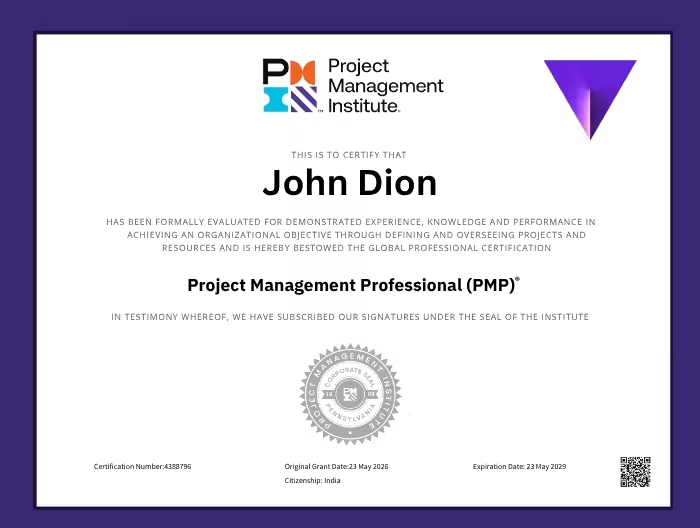
      PMP Certificate
      Certificate Benefits:
      • PMI Continuing Professional Development Units (PDUs)
      • LinkedIn Digital Badge
      • Enhanced Career Opportunities
      • Lifetime Access to Updated Learning Materials
      • Exam Preparation Support
      • Industry-Relevant Skills

      Online PMP Training: 3 Ways to Get PMP Certified Online

      Online PMP training has become a popular and effective way to prepare for the PMP exam. The best programs now offer flexible study options, expert guidance, practice exams, and strong exam support. But every learner is different. Some people prefer live classes, some want to study at their own pace, and others need a fast-track option. Here are the three main ways to complete your PMP certification training online.

      Duration: 4 Days
      1

      1. Live Online PMP Training

      Live online training gives you scheduled classes with a PMP-certified instructor. You can ask questions, discuss real project examples, review case studies, and get feedback during the course. Most live sessions are also recorded, so you can watch them again later if you miss anything.
      Best for: People who learn better with instructor support, live discussion, and a fixed study schedule.
      2

      2. Self-Paced Online PMP Training

      Self-paced PMP training lets you complete the required 35 hours of course content on your own schedule. You can watch videos, review study materials, complete practice questions, and take mock exams whenever you have time. This option is ideal for busy professionals who cannot attend fixed class sessions.
      Best for:
      Self-motivated learners who want full flexibility.
      3

      3. Intensive PMP Bootcamp

      A PMP bootcamp is a short, focused training program completed in 4–5 days. It covers the 35 required training hours quickly and focuses heavily on exam strategy, key concepts, and practice questions. This format is intense, so it is best for people who already understand project management basics.
      Best for: Professionals who already have project management experience and want fast, structured exam preparation.

      Demand for PMP Certified Professionals

      Average Salary (US)

      $85K
      $120K
      $155K
      Min Average Max

      Hiring Companies

      Demand

      Up to 64%

      Projected growth in demand for project professionals by 2035

      Average Salary (US)

      $105K
      $125K
      $155K
      Min Average Max

      Hiring Companies

      Demand

      High Urgency

      Agile and digital transformation programs need qualified delivery leaders across tech domains.

      Average Salary (US)

      $125K
      $155K
      $185K
      Min Average Max

      Hiring Companies

      Demand

      Strategic Role

      Critical organizational role driving project portfolio management and governance.

      Average Salary (US)

      $160K
      $185K
      $210K
      Min Average Max

      Hiring Companies

      Demand

      Executive Level

      Senior leadership positions requiring extensive experience and strategic vision.

      Salary figures are indicative US-market ranges in USD, based on PMI's Earning Power Salary Survey (US PMP median: $135,000) and 2026 US role-range data. Sources: PMI – Global Project Management Talent Gap Report (2025) · PMI – Earning Power: Project Management Salary Survey, 14th Edition · PMI – Shortage of Project Talent Endangers Global Growth

      Top Roles and Salaries with a PMP Certification

      While project management skills are highly transferable, earning your PMP credential opens direct pathways to elite leadership roles. Because the PMP validation is so rigorous, organizations are willing to pay a premium for certified talent.

      • Project Manager
        • Core Focus & Responsibilities: Oversees the entire project lifecycle from initiation to closure. Owns the scope, timeline, and delivery across tech, construction, healthcare, or finance.
        • Average Annual Salary Range: $114,000 – $177,000 (Global)
          ₹10L – ₹17L+ (India)
      • Project Lead
        • Core Focus & Responsibilities: A more hands-on, operationally focused role. Leads daily execution, acts as a task manager, and ensures team alignment on deliverables.
        • Average Annual Salary Range: $78,000 – $112,000
      • PMO Lead
        • Core Focus & Responsibilities: Establishes, maintains, and optimizes project management standards, frameworks, governance, and tools across the entire enterprise.
        • Average Annual Salary Range: $88,000 – $112,000
      • Project Director
        • Core Focus & Responsibilities: A senior executive who oversees portfolios of multiple large-scale projects and programs, ensuring deep alignment with overarching business strategy.
        • Average Annual Salary Range: $144,000 – $213,000+

      Note: Salaries vary based on geographic location, industry, and years of practical experience.


      Is PMP certification worth it? What the data says

      PMP-certified project managers consistently out-earn non-certified peers. According to PMI's Earning Power: Project Management Salary Survey:

      • India: PMP holders report a median roughly 20–33% higher than non-certified peers, with typical ranges of ₹16–30 LPA depending on city, sector, and experience (senior PMPs in Bengaluru and Mumbai often exceed ₹30 LPA). (Sources: PMI Earning Power Survey; corroborated by Naukri/LinkedIn India salary data. Figures are self-reported and vary by market.)
      • United States: average around $115,000, versus roughly $95,000 for comparable non-certified roles.
      • Global: PMI reports PMP holders earn meaningfully more than non-certified peers across the 21 countries surveyed.

      Demand is structural, not a fad. PMI's Global Project Management Talent Gap report projects the world will need up to 29.8 million additional project professionals needed by 2035, against roughly 40 million working today. In the U.S., the Bureau of Labor Statistics projects project-management-specialist roles to grow about 6% from 2024 - 2034, faster than the average occupation. (Sources: PMI Talent Gap 2025; U.S. BLS.)


      How Much Does PMP Certification Cost?


      COST ITEM PMI MEMBER COST NON-MEMBER COST NOTES

      Exam Fee

      ≈ US$405

      ≈ US$655

      PMI’s listed PMP exam fee; actual pricing can vary by region/taxes.

      Retake Fee

      ≈ US$275

      ≈ US$375

      Applies if you need to take the PMP exam again after an unsuccessful attempt.

      Renewal Fee

      ≈ US$60

      ≈ US$150

      PMP renewal is separate from PMI membership renewal; renewal requires meeting PMI’s CCR/PDU requirements.

      PMI Membership

      ≈ US$139/year*

      US$0

      Membership is optional. It can provide discounts on certification and other PMI products/services.

      Training Fees

      ≈ $2499.00 (Classroom Training)

      ≈ $899.00 (Live Online Training)

      ≈ $2499.00 (Classroom Training)

      ≈ $899.00 (Live Online Training)

      Current training price

      PMP exam format at a glance (2026)

      ELEMENT DETAIL

      Total questions

      180 (170 scored + 10 unscored pretest)

      Time

      240 minutes (4 hours)

      Breaks

      Two optional 10-minute breaks

      Domains

      People (33%), Process (41%), Business Environment (26%)

      Approaches

      Predictive, agile, and hybrid across all domains

      Question types

      Multiple choice, multiple response, matching, hotspot, drag-and-drop, case studies

      Delivery

      Pearson VUE test center or online proctoring

      PMI exam fee

      US$405 non-member / US$655 member 

      Benefits of the PMP Certification Training

      Individual Benefits

      Project Management Skills

      Develop practical skills required to plan, manage, and deliver project outcomes that align with stakeholder expectations and business goals.

      Career Growth

      The PMP certification opens doors to leadership roles and higher-paying opportunities across industries.

      Boosts Earning Potential

      Individuals holding a PMP certification can earn 17% higher median salary globally than their non-certified peers, particularly in project-driven careers.

      Improves Professional Credibility

      Adding this globally recognized credential to your resume demonstrates your knowledge and expertise in leading successful projects.

      Strengthens Problem-Solving Ability

      Gain the practical expertise needed to adapt to changes, mitigate risks, and effectively overcome project challenges.

      Organizational Benefits

      Improves Project Planning

      PMP-trained employees help organizations establish clear project goals, allocate resources efficiently, and maintain realistic timelines.

      Risk Management

      Professionals develop the ability to identify potential risks early and implement effective strategies to minimize their impact.

      Minimizes Project Delays

      PMP-certified team members can manage schedules effectively and ensure projects are completed on time.

      Enhances Team Collaboration & Coordination

      The training improves communication and collaboration among teams, stakeholders, and clients for better project execution.

      Maximizes Project Success

      Organizations benefit from improved cost control, reduced risks, and higher-quality project outcomes.

      Free practice

      Take a free 50-question PMP® mock exam

      Scenario-based questions that mirror the real exam. Get your score plus a weak-area report.

      We only use your email to send the simulator and your results.

      Simulator on its way

      Check your inbox for the login link.

      • 50 scenario questions
      • Timed like the real exam
      • Weak-area report

      Customer Testimonials

      Corporate PMP Certification Training for Teams

      Upskill your team with customized PMP training designed around your organization's schedule and learning goals. Get a custom quote for your organization's training needs and help your team build stronger project management capabilities.

      Custom Scheduling
      Weekday, weekend, or blended formats built around your team's calendars.
      Volume Pricing
      Groups of 5+ receive tiered discounts. Larger teams save up to 40% per seat.
      Dedicated Support
      One point of contact for enrollment, reporting, and instructor coordination throughout the program.
      Branded Certificates
      Add your organization’s name along with PMI authorization on completion certificates.
      Corporate Training

      Ready to transform your team?

      Get a custom quote for your organization's training needs.

      Request Corporate Quote

      Course & Support

      What is PMP certification?
      PMP (Project Management Professional) certification is a globally recognized credential offered by the Project Management Institute (PMI). It validates a professional’s ability to manage projects, lead teams, and deliver results using standardized project management practices.
      What are the eligibility requirements for PMP certification?
      To apply for the PMP exam, candidates must meet one of the following requirements:
      To apply for the PMP exam, candidates must meet one of the following education and project leadership experience requirements:

      Option 1: Bachelor's Degree or Higher

      Bachelor's degree or higher from a recognized institution.
      36 months (3 years) of non-overlapping project leadership experience within the last 10 years.

      Option 2: High School Diploma or Equivalent

      High school diploma, GED, or equivalent secondary school qualification.
      60 months (5 years) of non-overlapping project leadership experience within the last 10 years.

      Option 3: Associate's Degree or Qualifying Vocational Qualification

      Recognized associate's-level, higher-certificate, or advanced technical/vocational qualification.
      48 months (4 years) of non-overlapping project leadership experience within the last 10 years.

      Option 4: PMI GAC-Accredited Degree

      Bachelor's or postgraduate degree from a PMI Global Accreditation Center (GAC)-accredited program.
      24 months (2 years) of non-overlapping project leadership experience within the last 10 years.

      Additionally, candidates must complete 35 hours of project management education or training. Active CAPM certification holders are exempt from documenting these training hours. Qualifying coursework from a GAC-accredited program may also satisfy the 35-hour requirement.
      Is PMP certification worth it for project managers?
      Yes, PMP certification can be a valuable investment for project managers looking to advance their careers. Many leading multinational companies value PMP-certified professionals for their project management skills and industry knowledge. The certification can strengthen your professional credibility, improve your earning potential, and open doors to leadership roles across industries.
      What salary can a PMP-certified professional earn?
      PMP-certified professionals generally report higher earning potential than their non-certified peers. According to PMI's 2025 Salary Survey (14th Edition), PMP-certified professionals earned a 17% higher median salary across 21 countries. In the United States, PMP-certified respondents reported a median annual salary of $135,000, approximately 24% higher than non-certified professionals. Actual earnings vary by country, industry, experience, and job role.
      Can I take PMP certification training online?
      Yes. PMP training is available in multiple formats:
      Live online instructor-led training
      Classroom training
      Self-paced online courses
      Many professionals prefer online training because it offers flexibility and global access.
      Is PMP certification recognized worldwide?
      Yes. PMP certification is recognized globally across industries. Organizations worldwide value PMP-certified professionals because the certification follows internationally accepted project management standards.
      What is included in PMP certification training?
      Most PMP training programs include instructor-led sessions, study materials, mock exams, practice questions, and exam preparation guidance.
      Can beginners take PMP certification?
      PMP certification is generally designed for professionals with project management experience. Beginners may start with entry-level certifications such as CAPM before pursuing PMP certification.
      What does the 36-month non-overlapping experience requirement mean?
      Only distinct calendar months of project-leading work count toward the total; overlapping projects don't stack. Experience must fall within the past 10 years.
      Do I need a four-year degree to apply for PMP?
      No — a secondary diploma qualifies too, just with 60 months of experience instead of 36.
      What's the step-by-step process to become PMP certified?
      To become PMP certified, first confirm that you meet PMI’s eligibility requirements, complete 35 hours of project management education (or hold an active CAPM certification), submit your application to PMI, obtain approval and pay the exam fee, schedule your exam through Pearson VUE, and pass the PMP examination.
      What are the steps to download/access my PMP certificate?
      Log in to your PMI account, navigate to My Certifications, and click View Certificate to download your PMP certificate as a PDF.
      What's the renewal process and fee once my 60 PDUs are earned?
      Log your 60 PDUs through PMI’s Continuing Certification Requirements (CCR) system within your 3-year renewal cycle, then pay the renewal fee of $60 for PMI members or $150 for non-members.
      What is a PMI Membership, and is it worth it?
      A PMI Membership is an annual $139 subscription to the Project Management Institute. It offers resources, networking, and exam discounts. It is worth it if you plan to get or renew certifications, since PMP exam savings cover the membership fee.
      How can I verify my PMP certification status?
      You can verify your PMP certification status through the PMI Certification Registry by searching with your first and last name. Employers can also use this registry to confirm your credentials.
      What should I do after earning my PMP certification?
      After earning your PMP certification, update your resume, LinkedIn profile, and email signature, and add your certification ID to boost visibility with recruiters.
      Is the PMP exam open-book? Can I use a calculator?
      The PMP exam is closed-book. You may use a provided calculator or the built-in digital calculator during the exam.
      How long does it take to complete PMP certification training?
      The PMP certification training at iCertGlobal is delivered through a 4-day instructor-led bootcamp covering key project management concepts, exam preparation, and practical learning activities.
      How long is the PMP certification valid?
      PMP certification is valid for three years. To renew it, professionals must earn 60 Professional Development Units (PDUs) within this period and pay the renewal fee.
      What industries use PMP-certified professionals?
      PMP certification is used in many industries, including: Information Technology Construction Healthcare Banking and Finance Manufacturing Telecommunications Government projects
      What is the recommended preparation time before taking the PMP exam after training?
      Candidates are encouraged to schedule their PMP exam within 4–8 weeks after completing training as a preparation guideline. This is not a mandatory PMI deadline. PMI allows candidates a one-year eligibility period from application approval to take the exam. Candidates should choose an exam date that gives them enough time to revise, practise mock tests, and address knowledge gaps.
      Is there any support available for the PMP exam application process?
      Yes. Our team provides guidance on the PMP application process, including eligibility verification, application submission, documentation requirements, and exam scheduling support.
      Can I attend PMP training online, or is it only classroom-based?
      iCertGlobal offers flexible learning options, including instructor-led online training, self-paced learning, and classroom sessions (subject to availability). You can choose the format that best fits your schedule and learning preferences.
      Can I pay for the PMP course in installments/EMI?
      Yes, EMI and installment options are available through our payment partners.
      What happens if I miss a live class? Can I access a recording?
      Yes. Every live session is recorded and posted to the learning portal, usually within 24 hours.
      Will my previously completed PMP training remain valid after 1 December 2026?
      Yes. According to PMI, qualifying project management training completed before 1 December 2026 remains eligible under the requirements in effect at the time, provided it meets PMI's applicable eligibility criteria. This includes training delivered by PMI Authorized Training Partners (ATPs) or Registered Education Providers (REPs), as applicable under the requirements in effect when the training was completed.
      Not sure whether your hours qualify? Read our guide: Will my live PMP hours count after PMI's rule change?
      How is the latest PMP exam structured under the PMBOK® Guide – 8th Edition framework?

      The latest PMP® exam aligns with modern project management practices reflected in the PMBOK® Guide – 8th Edition and the PMI Examination Content Outline (ECO).

      Exam Structure
      • 180 questions completed within 230 minutes
      • Question types include multiple choice, multiple response, matching, drag-and-drop, and scenario-based questions
      • Covers predictive, agile, and hybrid project management approaches
      Domain-Wise Weightage
      • People — 33% Leadership, team performance, collaboration, and conflict management
      • Process —41% Planning, execution, risk management, quality, and delivery practices
      • Business Environment — 26%: Strategy alignment, governance, compliance, and organizational impact
      Latest Emerging Trends Covered
      • Value Delivery Focus: Managing projects to achieve measurable business outcomes and stakeholder value
      • AI-Driven Project Management: Using data, automation, and intelligent tools to support decision-making and project forecasting
      • Sustainability & ESG Practices: Integrating environmentally and socially responsible project approaches Adaptive Leadership: Leading teams effectively in complex and rapidly changing environments
      Who should take PMP certification training?
      PMP training is ideal for professionals who want to build or advance their careers in project management. It is commonly pursued by: Project Managers Team Leads Program Managers IT Managers Business Analysts Engineers and Consultants Professionals who manage projects or plan to move into leadership roles can benefit from this certification.
      What is the PMP exam format?
      The PMP exam consists of: 180 questions 240 minutes exam duration Multiple choice, multiple responses, matching, and scenario-based questions. The exam covers three major domains: People Process Business Environment
      How much does the PMP certification exam cost?
      The PMP exam fee depends on PMI membership status. PMI Members: $405 Non-Members: $655 Training providers may charge additional fees for certification preparation courses. While the exam fee is decided by the PMI, the PMP certification cost can vary as per the training provider and learning format.
      How can I apply for the PMP exam?
      To apply for the PMP exam, follow these steps: Create a free account on the PMI website. Check that you meet PMI's education, project management experience, and training requirements. Complete the online PMP application with your education, project experience, and training details. Submit your application for PMI's review. If selected for an audit, provide the requested supporting documents. Once your application is approved, pay the applicable exam fee through your PMI account. Schedule your exam through Pearson VUE by choosing an available date, time, and exam f
      How difficult is the PMP certification exam?
      The PMP exam is considered challenging because it tests how well candidates apply project management concepts to real-world scenarios rather than simply recall information. Its difficulty can vary depending on your project management experience, familiarity with the exam content, and level of preparation. Structured training, thorough revision, and regular practice tests can help you build confidence and improve your chances of passing.
      How many attempts are allowed for the PMP exam?
      Candidates can take the PMP exam up to three times within one year after their application is approved.
      What study materials are provided for PMP exam preparation?
      iCertGlobal’s Project Management Professional course aims to boost your exam preparation through instructor-led training materials, PMBOK® 8th Guide references, practice questions, mock exams, case-based exercises, and exam strategy resources. These materials help candidates understand project management concepts, exam domains, and real-world scenario-based questions.
      Are PMP mock exams included in the training?
      Yes, the PMP certification training includes mock exams and practice tests that simulate the actual PMP exam environment. These tests help candidates assess their readiness, improve time management, and identify weak areas before taking the official exam.
      Does the PMP exam include Agile and hybrid project management questions?
      Yes. PMP exam preparation should cover predictive, Agile, and hybrid project management approaches.
      How do I know if I am ready to take the PMP exam?
      You may be ready for the PMP exam when you consistently perform well on mock exams, understand the key exam domains, can answer scenario-based questions confidently, and can apply Agile, hybrid, and predictive project management concepts in practical situations.
      What's the process to reapply for the PMP exam after failing all 3 attempts?
      If you do not pass the PMP exam after three attempts within your one-year eligibility period, you must wait one year from the date of your last exam attempt before submitting a new application. After the waiting period, you can reapply through PMI, pay the applicable exam fee, and follow the standard application and scheduling process. The one-year waiting period is correct. PMI also allows candidates who have failed three times to apply for a different PMI certification during that period.
      Can I take the PMP exam remotely (online proctored)?
      Yes. PMI offers the PMP exam online through Pearson VUE's OnVUE proctoring service, or in person at an authorized Pearson VUE test centre. To take the exam online, you need a compatible computer, a working webcam and microphone, a stable internet connection, and a private testing space. After your application is approved, check the available exam delivery options through your PMI account when scheduling. Before booking an online exam, review Pearson VUE's system requirements and run its system test to confirm that your computer meets the technical requirements.
      What's the refund policy for the PMP exam fee itself (vs. training fee)?
      PMI's cancellation and rescheduling fees depend on when you make the change. You can reschedule your PMP exam at least 48 hours before your appointment without a rescheduling fee. However, if you cancel your exam within 30 days of the appointment, a US$70 cancellation fee may apply. Cancellations made within 48 hours of the appointment are not permitted, and you forfeit the exam fee if you miss the exam. These rules are separate from iCertGlobal's training refund policy.
      How do I schedule my exam after finishing training?
      After completing your training, submit your PMP application to PMI. Once PMI approves your application, pay the required exam fee through your PMI account. You can then select Schedule Exam to access Pearson VUE and book your preferred exam date, time, and format—either at a test centre or through online proctoring, where available.
      Will my training hours still count if I finish a live PMP class before PMI’s rule change?
      Yes. PMI states that training completed before the new live-training requirement starts remains eligible under the requirements in place at the time. From late Q4 2026, live PMP training must be delivered by a PMI Authorized Training Partner or another approved pathway to count.
      What skills will I learn in PMP certification training?
      PMP training helps professionals learn project planning, risk management, stakeholder communication, agile project management, leadership skills, and project execution techniques.
      What kind of support is there if I don't pass the exam?
      If you are unsuccessful in clearing the exam on your initial try, we provide free re-training, one-on-one mentorship, and extended access to our Project Management Professional course online simulator until you successfully earn your PMP certification.
      Can I get help from instructors outside of class hours?
      Absolutely. You have 24/7 access to our expert support team via a dedicated Slack channel and email. You also have the option to schedule one-on-one sessions for assistance with specific questions or difficult topics.
      My application was selected for a PMI audit. Can you help?
      Yes, we can. Being audited can be stressful, but we ensure you are fully covered. We offer complete, practical assistance to help you compile all the required documentation and successfully navigate the entire audit process.
      How do I enroll in PMP certification training?
      You can enroll by visiting iCertGlobal’s official website. Next, you need to select a preferred training schedule and learning format. Once registration is completed, you will receive confirmation details, access instructions, and guidance on how to begin your PMP certification preparation.
      Will I receive a certificate after completing the PMP training?
      Yes. After completing the PMP certification training, participants receive a course completion certificate. This certificate can be used as proof of the required project management education hours when applying for the PMP exam.
      What's the cancellation/refund policy if I cancel my training enrollment?
      The cancellation and refund policy depends on the training format and the specific course. For classroom training, cancellations made at least 7 days before the event are eligible for a refund after a 10% deduction. Cancellations made within 7 days of the event are non-refundable. For online training, cancellations requested within 48 hours of enrollment are subject to a 5% administration fee; requests made after 48 hours are generally non-refundable. Course-specific refund terms may also apply. Please refer to the iCertGlobal Refund Policy for complete details.
      What jobs can I get after PMP certification?
      After earning PMP certification, professionals can pursue roles such as: Project Manager Program Manager Project Coordinator PMO Manager Delivery Manager Operations Manager These roles are available across industries including IT, construction, healthcare, finance, and manufacturing.
      Can PMP certification help in career growth?
      Yes, PMP certification significantly improves career prospects by validating project management expertise and increasing opportunities for leadership roles.
      What are the benefits of PMP certification?
      PMP certification helps you demonstrate your ability to lead projects, manage resources, handle risks, and deliver business outcomes. It is globally recognized across industries and can strengthen your professional credibility when applying for project management roles or pursuing leadership opportunities. It can also improve your earning potential, as PMI's salary survey reports higher median salaries among PMP-certified professionals than their non-certified peers.
      Is PMP certification worth it for project managers?
      Yes. PMP certification is valuable for professionals who want to strengthen their project management credibility, qualify for senior roles, and demonstrate project leadership skills. It shows employers that you understand structured project delivery, risk management, stakeholder communication, budgeting, scheduling, and team leadership.
      Does PMP certification increase salary potential?
      Yes. PMP-certified professionals often have stronger earning potential because the certification is widely recognized by employers across industries. It can help candidates qualify for higher-paying roles such as Project Manager, Program Manager, Project Lead, PMO Manager, and Senior Project Consultant.
      Can PMP certification help me move into leadership roles?
      Yes. PMP certification helps professionals build leadership, strategic planning, decision-making, communication, and stakeholder management skills. These capabilities are useful for moving into senior project management, program management, portfolio management, and business leadership positions.
      Is PMP certification useful for professionals outside IT?
      Yes. PMP certification is not limited to IT. It is highly useful in construction, healthcare, finance, manufacturing, engineering, consulting, energy, telecom, government, and many other sectors where projects need to be planned, executed, monitored, and delivered successfully.
      How does PMP certification improve my professional credibility?
      PMP certification validates your project management knowledge, experience, and commitment to global best practices. It gives employers, clients, and stakeholders more confidence in your ability to manage complex projects, lead teams, control risks, and deliver measurable business outcomes.
      PMP vs. CSM (Certified Scrum Master) — which is better?
      PMP is better suited for professionals who want to manage projects across different methodologies, teams, and industries. CSM is ideal for those who want to specialize in Scrum, facilitate Agile teams, and support iterative product development. The right choice depends on your career goals and preferred project management approach.
      PMP vs. PRINCE2 — which suits my career goals?
      PMP is a good choice if you want to develop broad project management skills and work across industries, methodologies, and international markets. PRINCE2 is particularly useful for professionals working in organizations that follow its structured project management methodology, especially in the UK and parts of Europe. Choose based on your target roles, industry, and preferred project management approach.
      What certifications should I pursue after PMP?
      After earning your PMP certification, consider a specialization based on your career goals. PMI-ACP can help you deepen your Agile project management skills, while PMI-RMP focuses on project risk management. If you want to move into senior leadership, PgMP develops program management expertise, and PfMP is suited to professionals managing portfolios of projects and programs.

      Not sure PMP® is the right move?

      Book a free 15-minute counselling call — we'll map your eligibility, timeline, and salary ROI.

      • Your eligibility
      • Your timeline
      • Your salary ROI

      Free · 15 minutes · No obligation

      Book your free call

      Advisors available today

      Pick a time and we'll ring you.

      You're booked in

      An advisor will call you in your chosen slot.

      PMP Training in Other Cities